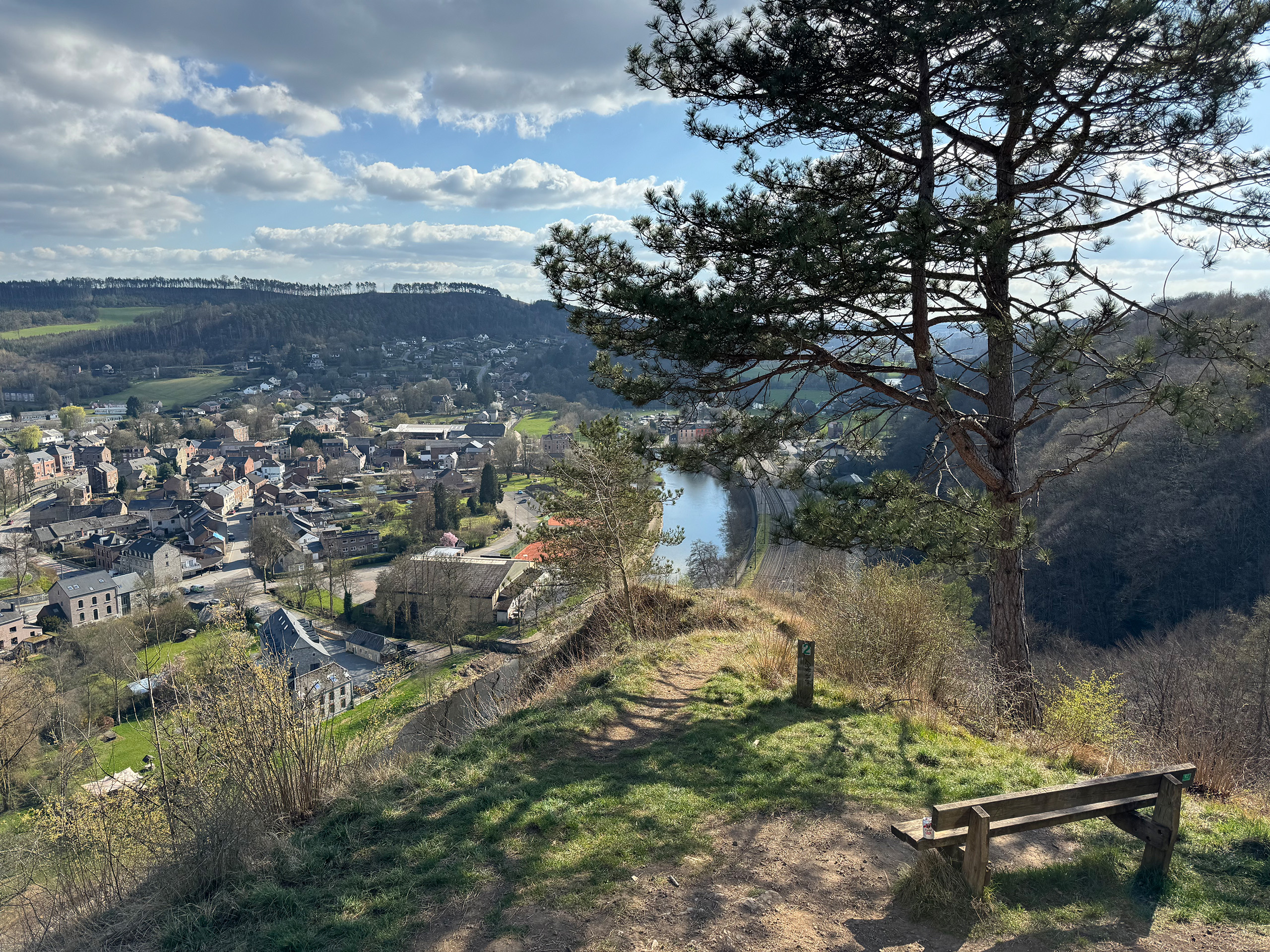
The south of Belgium is known for its low mountain ranges and river valleys, lined with sometimes adventurous rock formations as well as castles and palaces. The most famous is the Meuse Valley between Namur and the French border.
Of course, there are other scenic river valleys. One that I particularly like is the Ourthe Valley, which, apart from a few places, still seems to be a special hidden gem, even though it begins just south of Liège.
The Ourthe is a right-bank tributary of the Meuse. It originates from the confluence of the Eastern Ourthe (whose source is near the village of Ourthe in the municipality of Gouvy) and the Western Ourthe (whose source is near the village of Ourt in the municipality of Libramont-Chevigny), both in the Luxembourg province of Belgium. In the province of Liège, south of the city of Liège, the Ourthe flows into the Meuse.
Let’s take a small journey along the Ourthe from Liège to La Roche-en-Ardenne. The travel times and distances given refer to car travel.
Note: To keep this article reasonably concise, I have focused on the main highlights. There are numerous other sights along the route.
Liège
Liège is a fascinating major city on the Meuse and Ourthe rivers, with a history that extends far beyond the industrial age. In the city center, you will find impressive churches, architectural treasures, and old quarters framed by hills with stair-streets, parks, and spectacular viewpoints.
Nevertheless, Liège is not a typical tourist destination: Liège has suffered badly from the decline of heavy industry. Despite massive efforts in the form of impressive urban development projects, the city still struggles, which is evident in many places.
Liège has enough attractions for a stay of several days. If you prefer a more relaxed start, begin your Ourthe tour at the southern tip of the Meuse Island at La Boverie, not far from the Ourthe’s mouth.
Driving time Liège-Angleur – Esneux-Tilff: 8 min (9 km)
Tilff
Tilff (municipality of Esneux) is a small village located just south of the Liège-Sart Tilman hills (home to university buildings and the university hospital). You can take the E 25 highway, which offers impressive views as you approach Tilff.
Tilff has a quiet, picturesque riverbank and a charming shopping street running parallel to it. An architecturally interesting two-story bridge connects the well designed main square with the Saint Léger Church and the historic train station on the opposite side, which is perhaps one of the most beautifully situated railway stations in Belgium.
Driving time Esneux-Tilff – Esneux: 6 min (5 km)
Esneux
The slightly larger village of Esneux impresses with its panorama: from the bridge, you can see a riverside with beautiful facades that house cosy cafés and restaurants, overlooked by the Saint-Hubert Church (accessible via a stair-street) and a historic castle in a confectionery-like architectural style (privately owned). Esneux is great for hiking, and afterward, you can relax in one of the cafés or restaurants.
Driving time Esneux – Comblain-au-Pont: 11 min (10 km)
Comblain-au-Pont
Comblain-au-Pont is my secret tip. While it may look unremarkable at the riverbank, the gentle climb to Place Leblanc is well worth it. At its end, you will find not only the Comblain-au-Pont Church but also the Saint Martin Hill. The ascent just behind the buildings of the square is picturesque, and at the top, there is an old, small cemetery with a tower. The view from the hill over the village is impressive. On the other side of the river, there is another scenic viewpoint on Rue du Thier Pirard (the part beyond the first hairpin bend can only be accessed on foot).
Driving time Comblain-au-Pont – Hamoir: 9 min (8 km)
Hamoir
Hamoir has everything a village in this area needs: a cozy riverside, a shopping street (Rue du Pont), a church (de la Vierge-Marie de Hamoir), and a rock formation. The Rocher de Coisse is particularly impressive, accessible only on foot, but it offers a magnificent view of the village.
Hamoir is also a hub for travelers with its train station. The municipality belongs to four different natural regions: the Ardennes (in the forests east of Filot), the Calestienne (in Filot), the Famenne (in a large part of Hamoir, Fairon, and Comblain-la-Tour), and the Condroz (in Sparmont and Lawé).
Driving time Hamoir – Ferrières-Logne: 10 min (9 km)
Logne
Logne (municipality of Ferrières) is a tiny village (a hamlet of the village Vieuxville) with a major highlight: Logne is best known for the ruins of its medieval castle, rising on its western flank. It is located in the tourist-friendly Domaine de Palogne, which features a museum and various recreational activities.
Driving time Ferrières-Logne – Durbuy-Bomal: 5 min (4 km)
Bomal
Bomal (municipality of Durbuy) is a pleasant village, though somewhat quiet and unremarkable. However, it boasts a true highlight on this journey: the Rocher du Calvaire. From Champoutre (a narrow commercial area squeezed between railway tracks and a hill), a short but rather strenuous climb leads to the Calvary Rock, offering a breathtaking view of the village and its surroundings.
Driving time Durbuy-Bomal – Durbuy: 9 min (8 km)
Durbuy
Durbuy, known as the smallest city in the world, is no longer a hidden gem. It is famous for its charming old town filled with beautiful hotels, restaurants, cafés, and shops. Additionally, the city offers numerous (sporty) leisure activities in the Durbuy Adventure Valley. In summer, Durbuy has a holiday atmosphere similar to the coast, but remains very relaxed.
Driving time Durbuy – Hotton: 12 min (12 km)
Hotton
Hotton is tiny but charming. It features green riverbanks, an Ourthe island with an idyllic park, and the Notre-Dame Consolatrice Church, which almost stands in the water.
Driving time Hotton – La Roche-en-Ardenne: 15 min (17 km)
La Roche-en-Ardenne
We reach our final destination, La Roche-en-Ardenne. A picture-perfect small town and a prime example of an Ardennes village: a winding river, squeezed between hills and rocks, beautiful riverbanks, a picturesque old town, and a castle (castle ruins) on a rock – the “Rock of the Ardennes”. La Roche is somewhat remote and overshadowed by more famous places like Dinant or Bouillon, but it is well worth visiting. While the castle itself is a must-see, the best view of the village (including the castle) is from the higher Belvédère de la Roche.
The return journey to Liège only takes 45 minutes.


 © VisitBelgium.net

 © VisitBelgium.net
 © VisitBelgium.net
 © VisitBelgium.net