
Tag Archive for: Charleroi

Charleroi was one of the most important industrial regions in Europe in the 19th and early 20th centuries. Coal mining, steel production, glass manufacturing, and the chemical industry made the city an economic engine; entire districts were built around mines and factories, and Charleroi boomed.

The decline began gradually from the 1960s and especially the 1970s, when heavy industry entered a deep crisis: mines were closed, steelworks relocated or abandoned. Particularly in the 1970s and 1980s, Charleroi lost tens of thousands of jobs – with massive social and urban consequences.

In the 1980s, the decay became increasingly visible: industrial wastelands, vacant buildings, and oversized, partly unfinished infrastructure (such as the metro) shaped the cityscape. Only since the 2000s, and especially the 2010s, has the city been trying to reinvent itself – with cultural projects, urban renewal, and a conscious reinterpretation of its industrial heritage.

“The ugliest city in the world”

In 2008, the Dutch newspaper “De Volkskrant” published a reader survey: Charleroi was voted the ugliest city in the world. This had a huge media impact and still shapes its image today. Among urbex enthusiasts, people interested in industrial heritage, and adventure seekers, Charleroi has long been considered a highly exciting travel destination – but the publication of the article further boosted alternative tourism. There are numerous travel videos on YouTube.
What is it like today, in 2026?

Charleroi today is no longer what it once was. In the city center, many streets and squares have been newly paved and redesigned, including the banks of the Sambre. A huge shopping center has opened right in the center. There is a focus on high-quality street art. Work is being carried out on metro lines that were never opened. Decommissioned industrial facilities are being demolished.

All of this is undoubtedly remarkable. But it changes little about the economic situation, the high unemployment, the financial situation of residents, the enormous retail vacancy outside the shopping center, and the condition of the city away from the main squares.

I have been to Charleroi several times, but recently, on a sunny Saturday, I took a closer look at the city center:

We drove into the city center to park in the underground garage of the Rive Gauche shopping center. Well before reaching it, the road disappears underground. The parking garage felt surprisingly clean, as did the access points above. Inside, Rive Gauche is almost at odds with the city around it – modern, polished, and bustling. Shops are plentiful, and notably, none appear vacant. Stepping out onto Place Verte, just as full of people, but the atmosphere shifts. The square is spacious and pleasant at first glance, yet a certain roughness is immediately noticeable. A few beggars and visibly struggling individuals linger around – not overwhelming, but enough to change the mood. Police presence adds a sense of control, though not necessarily comfort.

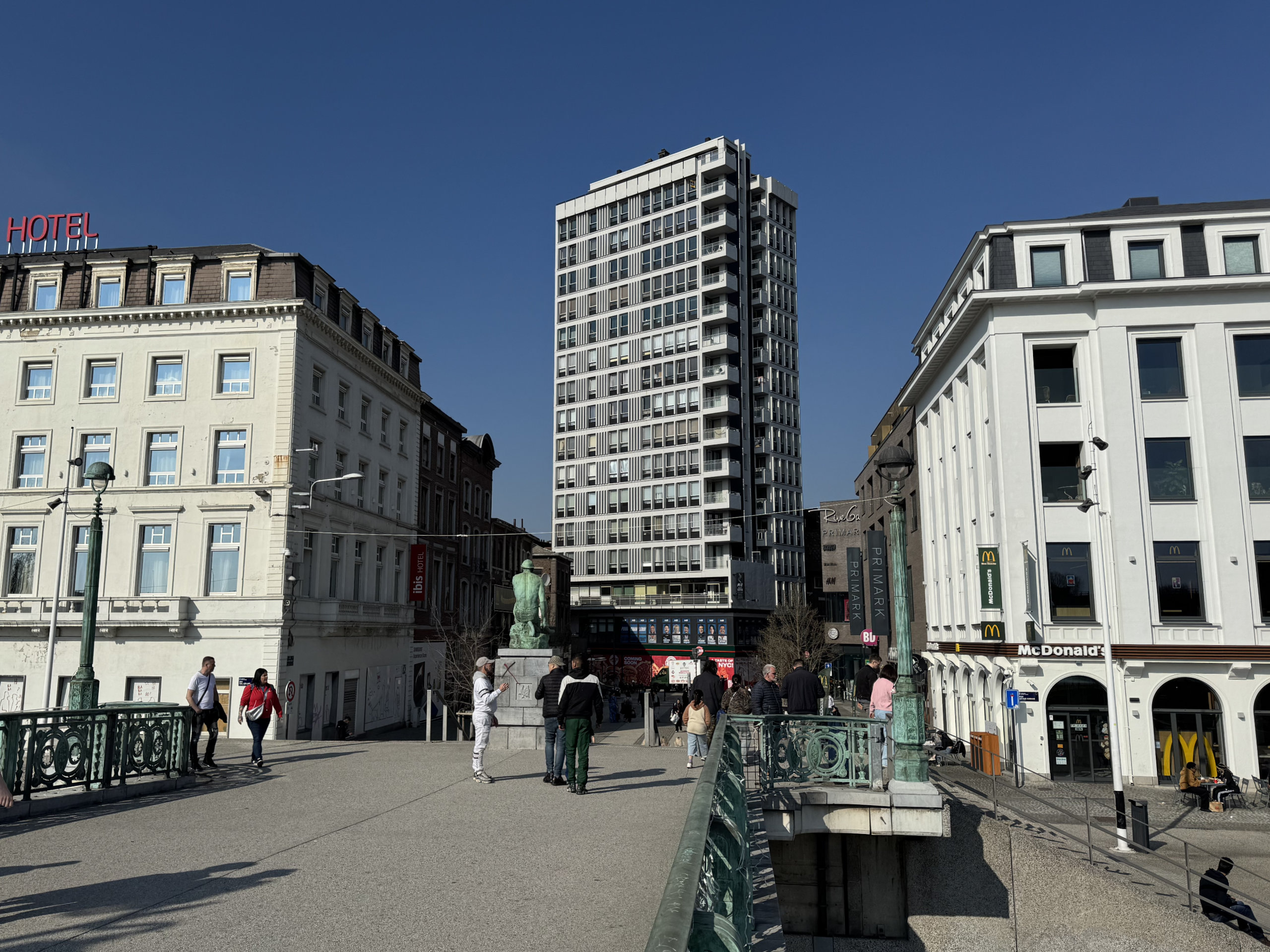
A short walk leads down to the Sambre. The river itself remains its familiar murky color, but the embankments have been thoughtfully renovated. Crossing the Pont Roi Baudouin towards the station, the urban fabric feels increasingly fragile. The station building is maintained, its forecourt redesigned, yet the sense of unease grows – again counterbalanced by visible policing. Back across the river, the city reveals its most striking contrasts. Around Place Émile Buisset and the surrounding streets, elegant historic facades stand alongside high-rise buildings, forming a dense and genuinely urban landscape. Yet at ground level, decline dominates: vacant storefronts, boarded-up spaces, even entire corners concealed behind advertising tarps.

Boulevard Joseph Tirou feels almost neutral – busy, functional, unremarkable. Just around the corner, Rue de Dampremy tells a different story. Despite its charm, only a handful of shops and cafés remain. The proximity to Rive Gauche makes the contrast even more apparent.

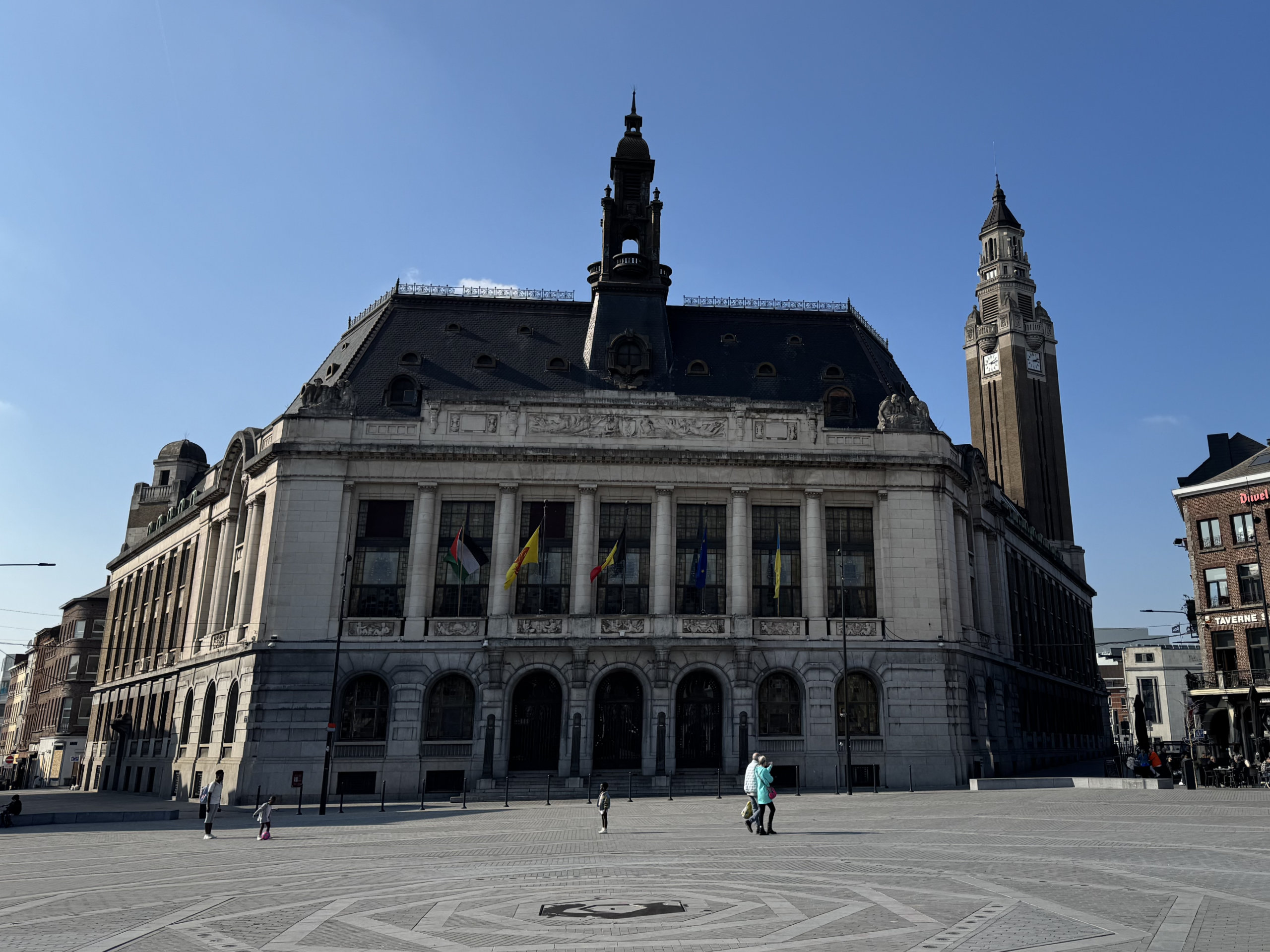
Climbing Rue de la Montagne into the upper town, the situation deteriorates further. Most shops are empty, mostly in poor condition. A few scattered discount stores remain, often adding to the sense of neglect. Ironically, the architecture above eye level is frequently beautiful – making the decay at street level all the more striking. From here on, the city begins to feel almost deserted. At the top lies Place Charles II: vast, impressive, freshly renovated – and nearly empty. The town hall and Saint-Christophe church lend it grandeur, and nine streets converge in a star-shaped layout, yet the space feels lifeless. Nearby, Place du Manège continues this pattern. Framed by the belfry and the Palais des Beaux-Arts, it too has been carefully restored, but remains largely devoid of activity. Only in one corner did a few people gather, with loud shouting audible – though not directed at us.

From there, we strolled back through various streets, walking past what appeared to be a crime scene in the making. At Place Verte, we descend into another underground parking entrance. Despite controlled access, it becomes noticeably dirtier with each level – ending in something resembling a grotto. Above ground, by contrast, the city center appeared strikingly clean.

Of course, this was only a snapshot. The atmosphere likely shifts dramatically after dark, and on a grey Sunday morning the experience might feel even more desolate.

One final impression, on the drive towards Marcinelle: police checking conspicuously dressed prostitutes, set against the chaotic backdrop of intertwined ring road and metro ramps – a scene that seemed to capture the city’s contradictions in a single moment.

I have never found Charleroi’s city center ugly, just run-down. And what about outside the city center?
outside the Center

The center is surrounded by the inner ring road, partly elevated, with its wild on- and off-ramps, with the metro and railway in between: this is truly ugly, but also extremely urban and fascinating. Especially the southwest of the ring has always reminded me somewhat of Metropolis.

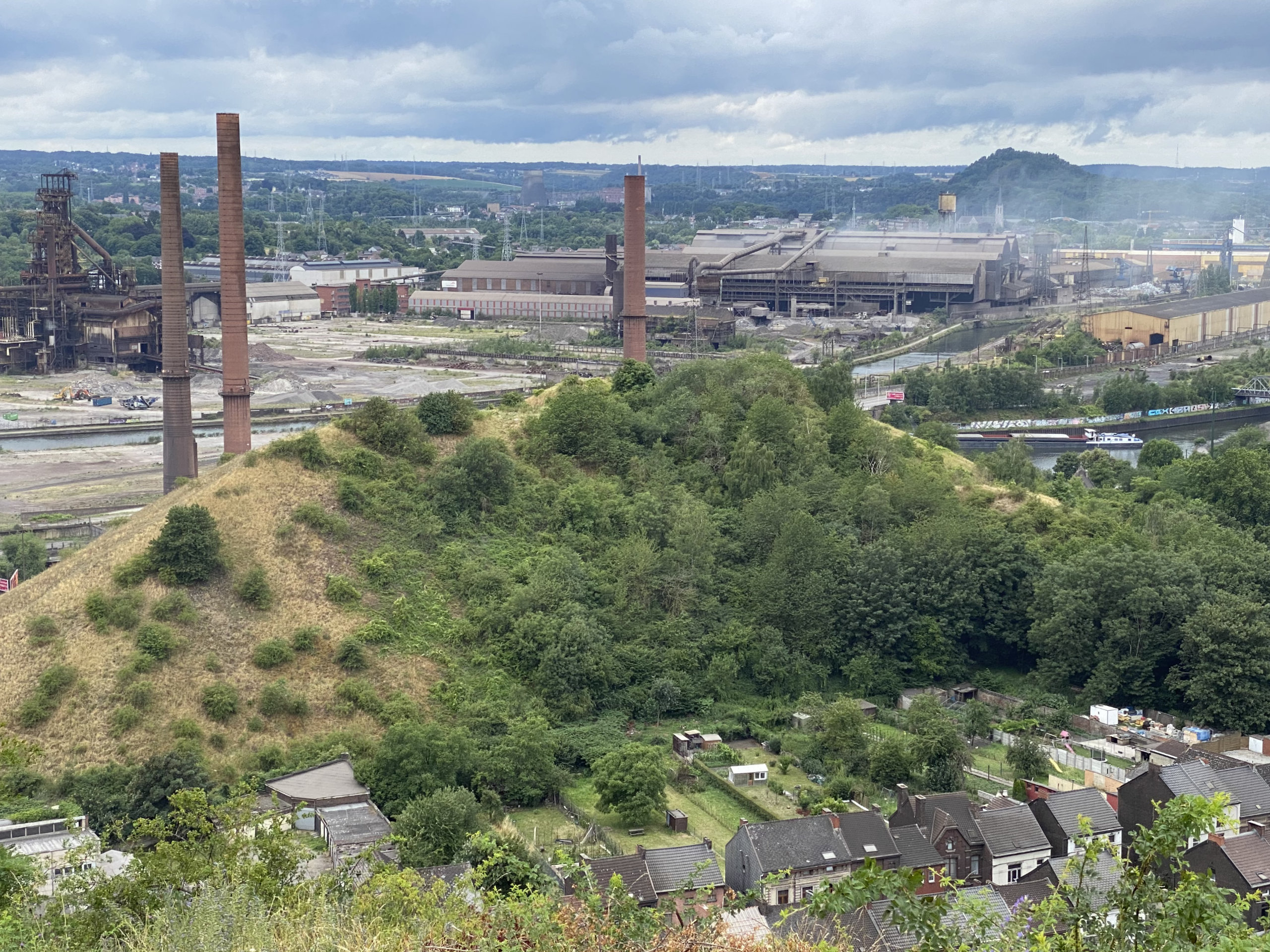
Outside the ring road: I know the western part quite well, but not the whole city (just from driving through it). Overall, Charleroi seems rough, worn out, cluttered, and scattered. But there are certainly nicer areas too. As for the western part of the city, I can say: working-class neighborhoods with simple brown brick facades, pothole streets, shabby shopping areas with odd shops, rubbish-strewn corners, dilapidation, industrial wasteland, brown-colored industrial buildings (everything generally monochrome), oversized infrastructure.

And of course slag heaps. The countless heaps, mostly wooded but usually bare at the top, form extremely interesting viewpoints, especially those close to the center. Some are well developed, while others require a more adventurous climb.

and Urbex?

Standing on the slag heaps, it becomes clear: the impressive industrial scenery has largely disappeared. Charleroi still has numerous great spots along the Sambre towards the west, but it is no longer a continuous band. And construction work is underway on the famous ghost metro line ahead of its opening – after decades.

Conclusion: Charleroi is a city in transition, a lot is happening. But the struggle is far from over.
Large countries are characterized by their diverse landscapes and cities with distinct personalities. Belgium, however, is small: driving from north to south (Antwerp to Arlon) takes about 2.75 hours, while crossing from east to west (Eupen to Ostend) takes roughly 2.5 hours.

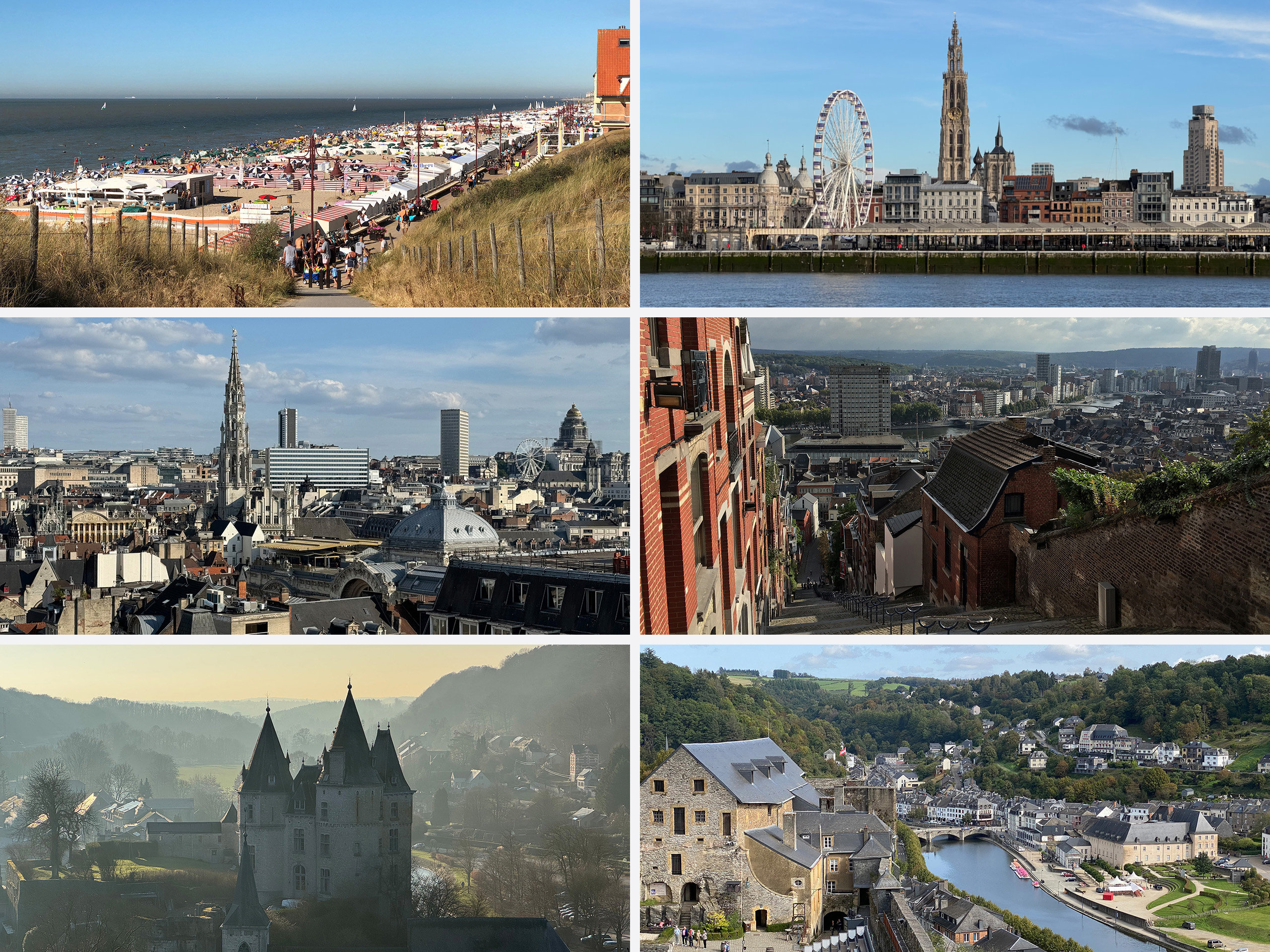
Despite its compact size of 30,000 square kilometers, Belgium offers an extraordinary variety: from fine sandy beaches along the North Sea coast, through the flat but water-rich region of Flanders, to the rolling hills of Wallonia, which are carved by deep river valleys.

Belgium has it all: vibrant metropolises like Brussels and Antwerp, museum-like art cities such as Bruges and Ghent, different types of coastal towns like Ostend and De Haan, thrilling industrial cities like Liège and Charleroi, and picturesque fortress towns like Dinant and Bouillon.

Of course, the diversity of Belgium is largely shaped by its two main regions: Flanders in the north and Wallonia in the south. Dutch (Belgian Dutch, which differs not only in the softer pronunciation) is spoken in Flanders, while French is the language in Wallonia. Near the German border, there is even a small German-speaking community, Ostbelgien (Eastern Belgium).

The appearance of Flanders and Wallonia is different, but with a few exceptions you can always recognise that you are in Belgium. Flanders does not look like the Netherlands, nor does Wallonia resemble France.

In fact, some neighboring cities in other countries exhibit Belgian influences, particularly Maastricht (Netherlands), Aachen (Germany), and Lille (France).

Now, let’s take a tour of seven cities. As a reference: driving through all seven city centers takes a total of 5 hours, covering a distance of 300 kilometers.

Ostend

With a population of 70,000, Ostend is the largest Belgian coastal city and serves as a major transport hub, connecting the main railway line (Cologne – Aachen -) Liège – Leuven – Brussels – Ghent – Bruges – Ostend with the coastal tramway. Despite its compact size, Ostend feels very metropolitan. In addition to its wide sandy beaches, the city offers a wealth of entertainment: excellent shopping, cozy cafés, outstanding restaurants, museums, a casino, and more. Tip: If Ostend feels too busy or built-up, take a 20-minute drive to the beautiful Belle Époque coastal town of De Haan.

Bruges

After a 30-minute drive, we reach Bruges. There’s little need to introduce this jewel of a city with 120,000 inhabitants: an absolutely perfect, living open-air museum with stunning churches, art treasures, picturesque squares, canals, and winding streets. While Bruges is very crowded in summer, it is very romantic in the other seasons.

Antwerp

After an 80-minute drive, we arrive in Antwerp (skipping over the must-see city of Ghent to keep this tour concise). Antwerp is a stunning Flemish metropolis of 530,000 residents, reknown for its huge port and its art and fashion scene. Lovers of culture, art, architecture, fashion and shopping will be delighted with what this city has to offer.

Brussels

An hour later, we reach Brussels, the bilingual heart of Belgium – an enclave within Flanders, close to the Walloon border. With a population of 1.2 million, Brussels is a metropolis that feels even larger and more urban due to its capital status. It boasts grand historical buildings, large churches, colossal palaces, royal museums, an awe-inspiring triumphal arch, the Atomium, Art Nouveau neighborhoods, and much more – everything a proud capital should have. However, Brussels is also affected by the decline seen in many European cities.

Charleroi

Shortly after leaving Brussels, we enter Wallonia. An hour later, we arrive in Charleroi, the largest city in Wallonia with 200,000 residents. Once a thriving industrial hub, Charleroi is not your typical tourist destination – it is, in most areas, run-down and even considered ugly, but that’s precisely what makes it famous. It attracts adventurous visitors interested in industrial history, urban art, and urban exploration.

Namur

Thirty minutes later, we find ourselves in a completely different world: the elegant Walloon capital of Namur, home to 110,000 people. Located at the confluence of the Meuse and Sambre rivers, Namur features a large fortress atop a hill, accessible by foot, cable car, or car. From there, visitors can enjoy beautiful views of the rivers, the historic city center, and the Meuse Valley. The city itself is filled with charming squares, inviting cafés, excellent restaurants, and stylish boutiques. It has a distinct southern European flair.

Dinant

Continuing through the lovely Meuse Valley, passing green mountains and fascinating rock formations, we reach our final destination: Dinant. This small town of 13,000 people is the postcard image of Wallonia: a river, a bridge, colorful houses, a grand church, and a massive rock formation crowned with a citadel. Tip: For those interested, a 20-minute drive along the Meuse River leads into France.

The belfry (Dutch belfort, French beffroi) is a significant architectural and historical landmark in Belgium, particularly in Flanders, but also in Wallonia and northern France. These imposing towers were erected in the Middle Ages by secular city authorities or guilds as symbols of civic power, often in contrast to that of the Church. Many of these belfries have been preserved in Belgium and are now part of the UNESCO World Heritage.

Most belfries were built during the Gothic period and rank among the most important secular buildings of the Middle Ages. Typically, a belfry is connected to the town hall or stands independently beside it.

As the safest place in a city, the tower usually housed the city archives and the treasury. Additionally, it served as a watchtower, with its bells warning the population of dangers such as fires or attacks, as well as announcing public matters. These duties were carried out by the tower keeper. A city bell also structured daily life, marking time and signaling various events.

Belgium is particularly rich in belfries. Their architectural designs are often stunning and reflect the craftsmanship of medieval builders. These structures showcase unique architectural styles, blending Gothic, Romanesque, and Baroque influences.

My personal Top 5 Belfries in Belgium

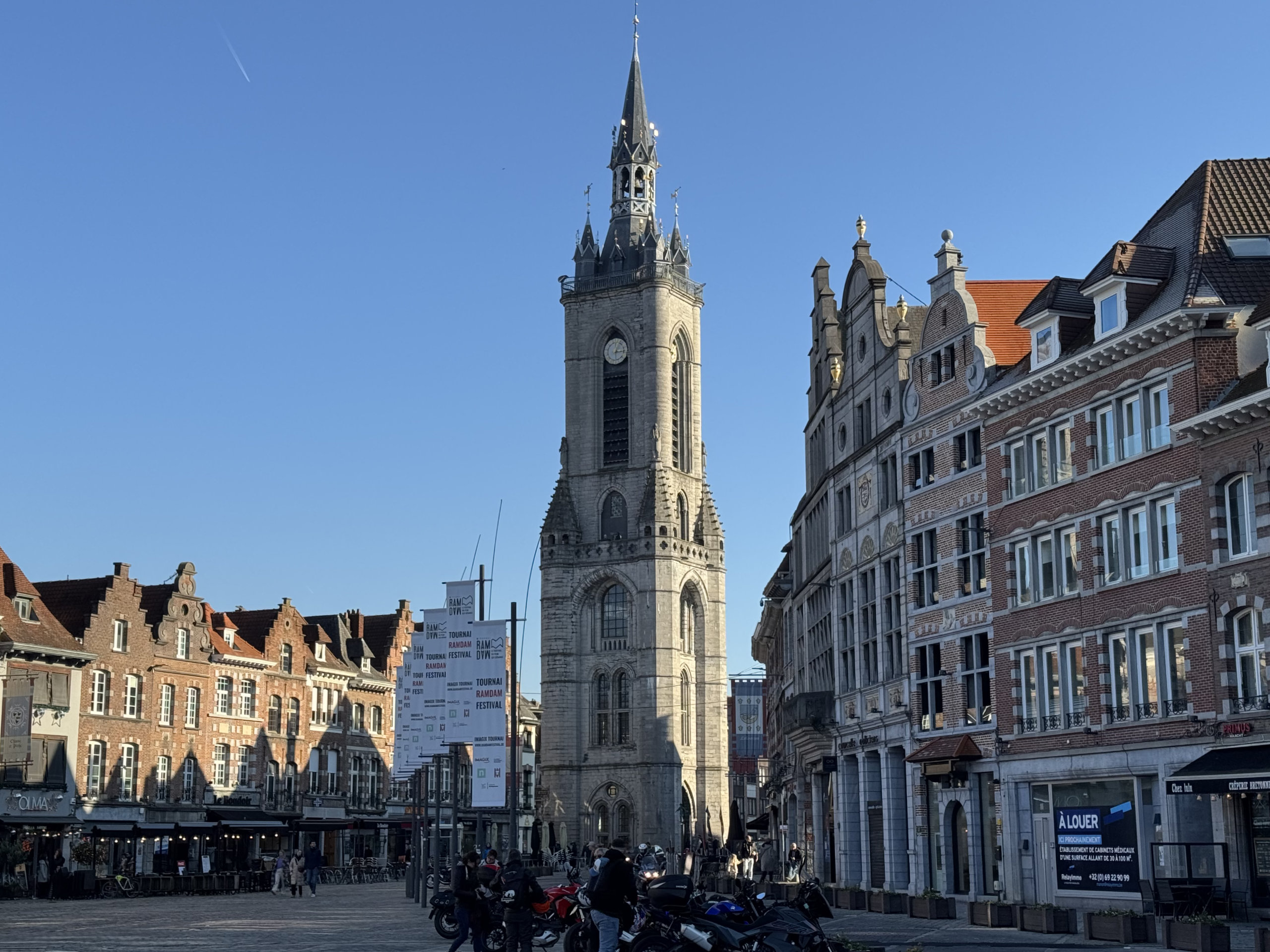
Tournai

The oldest surviving belfry stands in Tournai, built in the 12th century. At 72 meters high, it is not only the oldest but also one of Belgium’s most impressive belfries.

Bruges

The Belfry of Bruges is one of Belgium’s most famous and most visited towers. Standing 83 meters tall, it dominates the city’s market square. Built in the 13th century, it houses an impressive carillon with 47 bells.

Mons

Built in the 17th century in Baroque style, this is Belgium’s only Baroque belfry and a striking landmark of the city of Mons. It stands on an elevated site, away from the town hall.

Ghent

The Belfry of Ghent, built in the 14th century, is crowned with a dragon, which has become a symbol of the city.

Charleroi

A more recent belfry from the early 20th century, it is connected to the town hall of Charleroi and represents a modern interpretation of traditional belfries.

I would also like to mention the belfry of Lille, located in French Flanders, near the Belgian border. This tower is particularly slender and tall (104 meters) and was only completed in 1932. It impresses with its magnificent Art Deco style.

The belfries of Belgium and France were recognized as UNESCO World Heritage Sites in 1999, 33 of them in Belgium alone. This recognition highlights their historical and cultural significance. These towers are not only architectural masterpieces that reflect the history and development of medieval cities, but also symbols of freedom, self-governance, and economic prosperity.