
Belgium’s National Basilica: gigantic, yet overlooked
 © VisitBelgium.net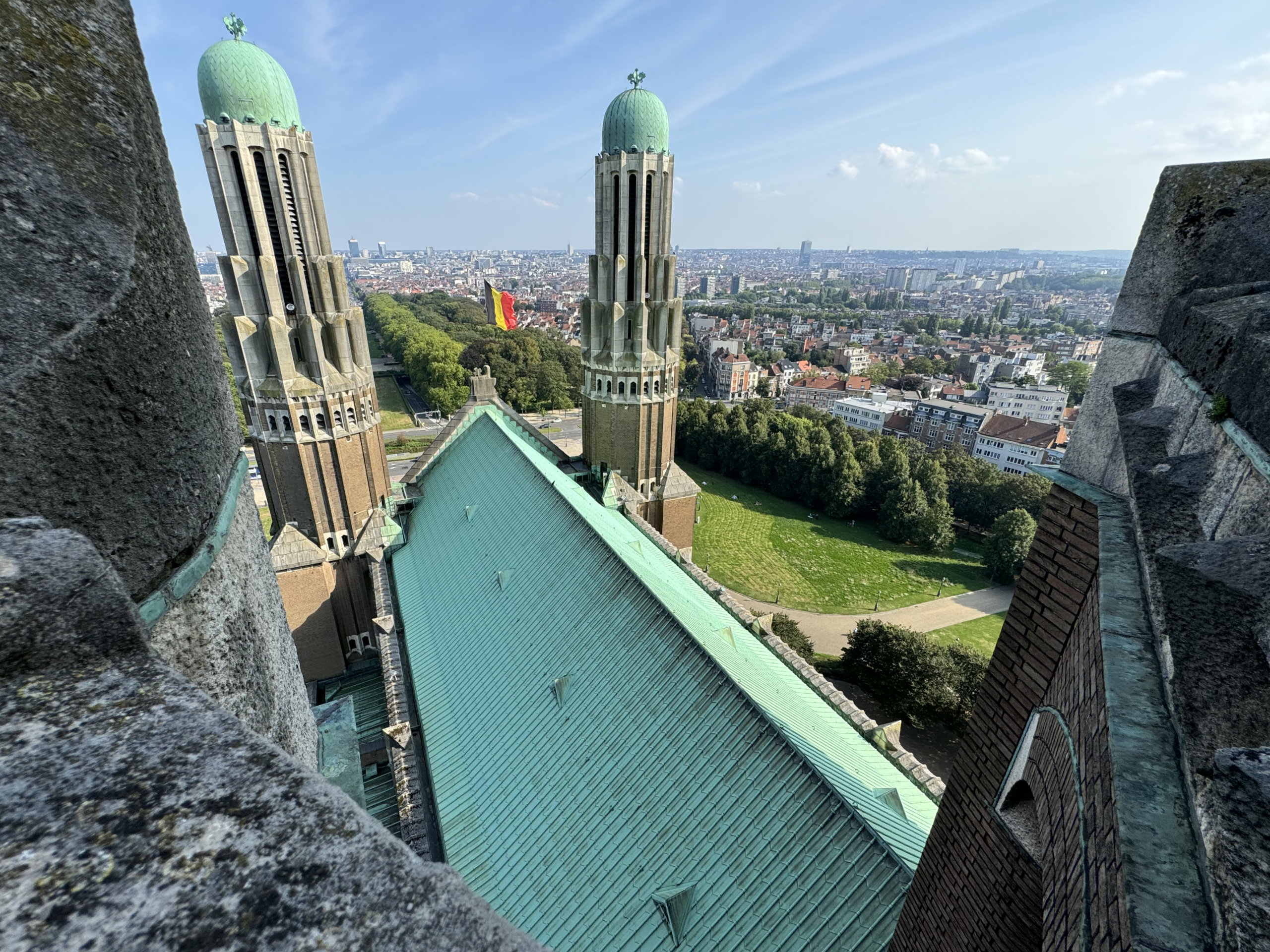
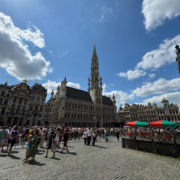
Most first-time visitors to Brussels head straight for the Grand Place, Cathedral, Mont des Arts, Atomium, and the Triumphal Arch. In doing so, many overlook a landmark that would rank among the most famous attractions in almost any other European capital: the National Basilica of the Sacred Heart.
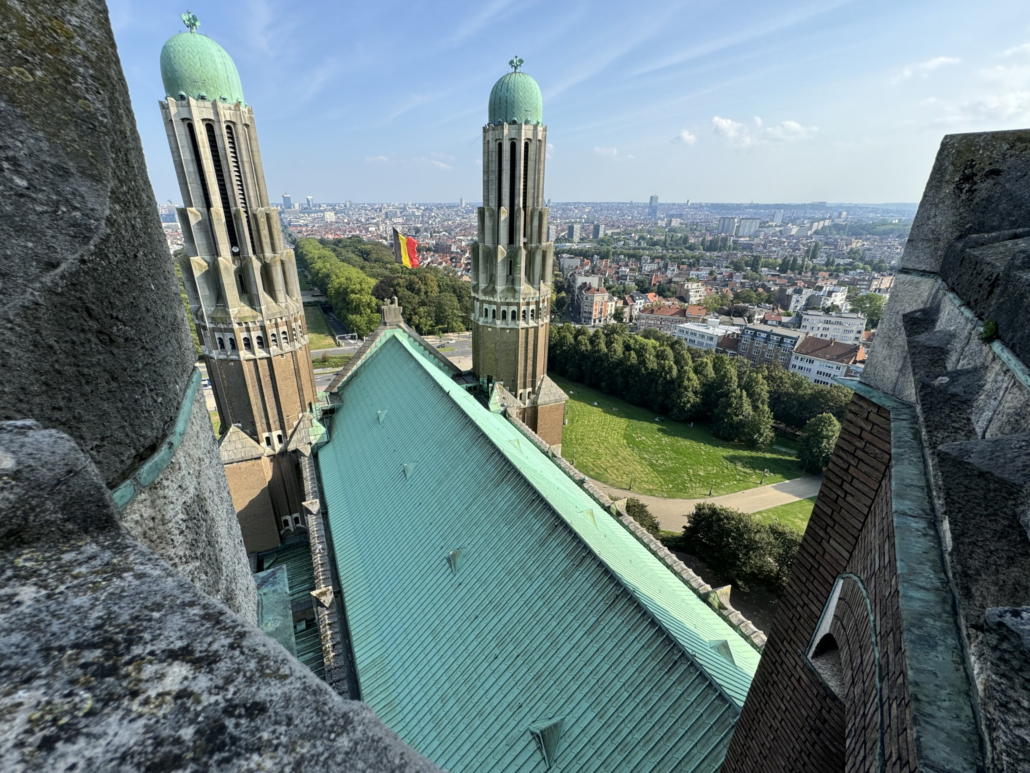
With its immense green copper dome, it dominates the northwestern skyline of the city. It is one of the five largest churches in the world, the largest Art Deco building in the world, and the monumental endpoint of one of Brussels’ longest visual axes. Despite all this, it remains far removed from the city’s traditional tourist routes.
A Monument of extraordinary Dimensions
The National Basilica is a structure of superlatives. It measures 165 meters in length and 108 meters in width, crowned by an 89-meter-high copper dome. Equally impressive is its location. The basilica rises on the Koekelberg Plateau at the end of Boulevard Léopold II. It was conceived as a striking urban focal point and the grand culmination of a monumental axis connecting northwestern Brussels with the city center. Its distinctive dome has become a defining feature of the capital’s skyline.
A royal Prestige Project
The story of the basilica began in 1905. To mark the 75th anniversary of Belgian independence, King Leopold II personally laid its foundation stone. Originally, however, the site was not intended for an Art Deco basilica but for a monumental Neo-Gothic church designed by architect Pierre Langerock.
The First World War brought the ambitious project to a halt. When construction resumed in the 1920s, architectural tastes had changed. Ghent architect Albert Van Huffel developed an entirely new design in the then cutting-edge Art Deco style. After his death, Paul Rome continued the project. Two world wars, economic hardship, and recurring financial difficulties meant that construction stretched on for decades. The basilica was finally consecrated in 1970, 65 years after the foundation stone had been laid.
Concrete instead of natural Stone
From the outside, the basilica appears to be a traditional monumental building made of natural stone. In reality, behind its exterior cladding lies a massive reinforced concrete structure, an exceptionally modern construction method for its time. The façade is clad in terracotta, brick, and natural stone, while the supporting framework fully reflects the engineering possibilities of the 20th century.
The interior also differs significantly from Europe’s great Gothic cathedrals. Clean lines and geometric forms dominate the space. Instead of elaborate historical ornamentation, the building embraces the restrained elegance of Art Deco.
Brussels is more than Art Nouveau
Brussels is best known around the world for its Art Nouveau architecture. Architects such as Victor Horta turned the Belgian capital into one of the movement’s most important centers. Less well known is the fact that, after the First World War, Brussels also became a major center of Art Deco. While the new style retained a commitment to high-quality design, it replaced the flowing floral motifs of Art Nouveau with clear geometry, symmetrical compositions, and modern materials. The National Basilica is the finest example of this architectural evolution.
A Church Interior from another Era
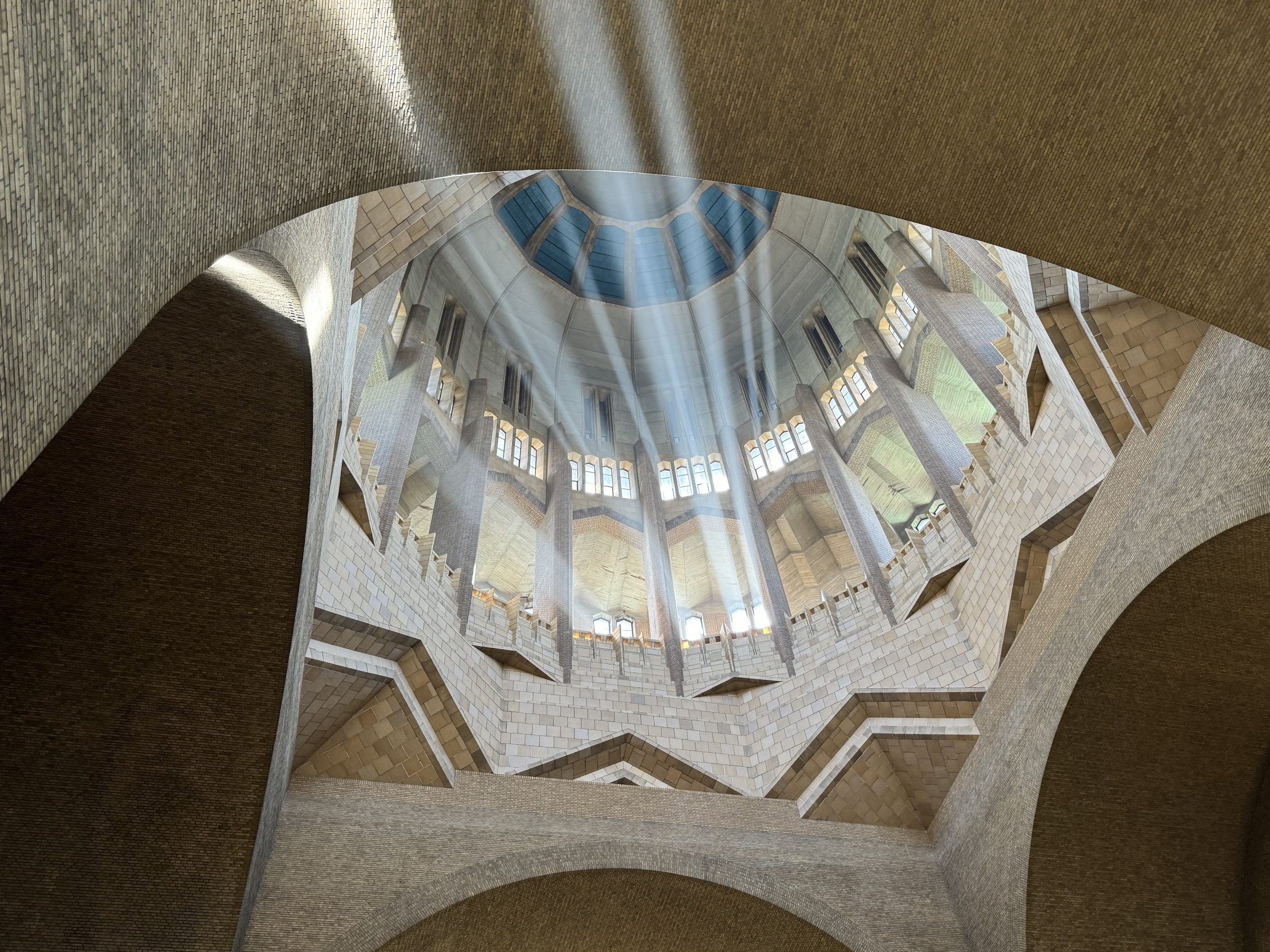
Anyone stepping inside immediately notices that this basilica has little in common with Belgium’s medieval cathedrals. Pointed arches, richly decorated altars, and colorful Gothic splendor are nowhere to be found. Instead, the space is defined by the almost futuristic clarity of Art Deco, massive pillars, and the understated monumentality of its reinforced concrete structure.
The immense scale of the nave is created not through lavish decoration but through the architecture itself. Albert Van Huffel conceived the building as a total work of art, with architecture, sculpture, stained glass, and liturgical furnishings designed as a unified whole. An original scale model of the basilica, which earned Van Huffel the Grand Prix for Architecture at the 1925 Paris International Exhibition, is also on display inside the building today.
More than a Landmark
Despite its monumental size, the National Basilica is not merely a monument. It remains an active church and serves first and foremost as a place of worship. In addition to regular religious services, it hosts national church celebrations, concerts, and special events. In 1952, Pope Pius XII elevated the church to the rank of basilica, officially recognizing its special significance within the Catholic Church. Pope Francis also visited the National Basilica in 2024, where he met with several thousand representatives of the Belgian Church.
The best View awaits at the Top
Anyone visiting the basilica should make sure to head up to the panoramic viewing platform. An elevator takes visitors to the exterior gallery surrounding the dome, approximately 53 meters above ground. From there, spectacular panoramic views extend across Brussels and far beyond the city’s limits.
For the descent, however, it is well worth skipping the elevator. A staircase leads directly through the interior of the structure and feels almost surreal. Instead of ornately decorated church interiors, visitors encounter exposed concrete walls in a distinctly Brutalist setting. It feels more like the emergency staircase of a modern hotel or parking garage than the inside of a monumental church. Yet this is precisely what reveals just how modern the building truly is. Behind its imposing exterior lies not a medieval stone monument but a rigorously engineered reinforced concrete structure of the 20th century.
Curious Facts about the Basilica
One unusual detail goes unnoticed by most visitors: strictly speaking, the National Basilica is not located within the City of Brussels, and it actually stands in two municipalities at once. The municipal boundary between Koekelberg and Ganshoren runs directly through the building. The fact that it is nevertheless commonly referred to simply as the “Brussels Basilica” illustrates just how complex the administrative structure of the Belgian capital really is. After all, the Brussels-Capital Region consists of 19 independent municipalities.
Equally remarkable is the contrast between its monumental appearance and its surroundings. Unlike the famous Sacré-Cœur in Paris, the National Basilica does not overlook a tourist district. Instead, it is nestled within Elisabeth Park and surrounded by residential neighborhoods. Those who come here usually do so with a clear purpose.
 © VisitBelgium.net
 © VisitBelgium.net
 © VisitBelgium.net
 © VisitBelgium.net
 © VisitBelgium.net
 © VisitBelgium.net
 © VisitBelgium.net
 © VisitBelgium.net
 © VisitBelgium.net
 © VisitBelgium.net
 © VisitBelgium.net
 © VisitBelgium.net
 © VisitBelgium.net
 © VisitBelgium.net