Tag Archive for: Brussels

In Belgium, flea markets and antiques hold a cultural significance that goes far beyond mere nostalgia. They reflect a deeply rooted appreciation for history, craftsmanship, and everyday aesthetics. The country, whose towns and cities have often preserved their medieval character, has a long tradition of trade and a rich material and industrial culture. Within this context, a refined sensitivity to the objects of the past has evolved – to furniture, household items, and artisanal works that have endured through time and tell fragments of lived history.

Please make sure to check online before your visit to confirm whether the flea market is taking place. This list has been compiled with great care, but dates may change, and even regularly scheduled markets may be cancelled, for example due to other events or public holidays. Opening hours may also vary, so it’s best to arrive early. The number of stalls can fluctuate significantly, depending on factors such as weather or holidays.

Below you’ll find the dates for particularly well-known and highly recommended antique and flea markets, which offer a wide variety of goods but no new items. You can find my personal favourites, details and tips here.

Every day

Brussels

TOP Marché aux puces du Jeu de Balle
Location: Place du Jeu de Balle
Time: 9 AM to 2 PM
Stands: 350

Sundays (weekly)

Antwerp

Antiek- & Brocantemarkt
Location: Sint-Jansvliet
Time: 9 AM to 5 PM
Stands: 100

Brussels

Sablon Antiques Market
Location: Grand Sablon
Time: 9 AM to 3 PM
Stands: 25

Ghent

Bij Sint-Jacobs
Location: Bij Sint-Jacobs
Time: 8 AM to 2 PM
Stands: 100

Herve

TOP Brocante du Marché Couvert de Battice
Location: Rue des Forges les Eaux
Time: 7 AM to 1 PM
Stands: 200

Raeren

Megahalle Hauset
Location: Aachener Straße
Time: 8 AM to 3 PM
Stands: 75

Spa

TOP Brocante de Spa
Location: Place Royale
Time: 7 AM to 2 PM
Stands: 100

Tongeren

TOP Antiekmarkt
Location: Leopoldwal
Time: 7 AM to 1 PM
Stands: 350

Tournai

Brocante des Bastions
Location: Boulevard Walter de Marvis
Time: 4 AM to 1 PM
Stands: 100

Waterloo

Brocante du Lion
Location: Drève Richelle
Time: 7 AM to 1 PM
Stands: 300

from March to November

Bruges

op de Dijver
Location: Dijver
Time: 10 AM to 6 PM
Stands: 50

from March to October

Namur

Brocante de Jambes
Location: Quai de Meuse
Time: 7 AM to 1 PM
Stands: 100

Saturdays (weekly)

Brussels

Sablon Antiques Market
Location: Grand Sablon
Time: 9 AM to 3 PM
Stands: 25

Ghent

Bij Sint-Jacobs
Location: Bij Sint-Jacobs
Time: 8 AM to 2 PM
Stands: 100

Raeren

Megahalle Hauset
Location: Aachener Straße
Time: 10 AM to 3 PM
Stands: 75

from March to November

Bruges

op de Dijver
Location: Dijver
Time: 10 AM to 6 PM
Stands: 50

Fridays (weekly)

Antwerp

Vrijdagmarkt
Location: Vrijdagmarkt
Time: 9 AM to 1 PM
Stands: 50

Ghent

Bij Sint-Jacobs
Location: Bij Sint-Jacobs
Time: 8 AM to 2 PM
Stands: 100

Liège

TOP Brocante Saint-Pholien
Location: Boulevard de la Constitution
Time: 7 AM to 1 PM
Stands: 150

from June to September

Bruges

op de Dijver
Location: Dijver
Time: 10 AM to 6 PM
Stands: 50

Wednesdays (weekly)

Durbuy

Brocante Durbuy
Location: Parc de Julienas
Time: 7 AM to 1 PM
Stands: 100

Kortrijk

Eurometropolis Brocante Kortrijk
Location: Engelse Wandeling
Time: 7 AM to 1 PM
Stands: 100

Sundays (monthly)

first Sunday of every month from March to October

Arlon

TOP Marché aux Puces du Vieil Arlon
Location: Grand Place
Time: 7 AM to 1 PM
Stands: 250

Various dates

Antwerp

Brocantwerpen
Location: Grote Markt
Time: 10 AM to 6 PM
Stands: 100
Dates

Brussels

TOP Voddemet Brussels Flea Market
Location: Rue Picard
Time: 9:30 AM to 5:30 PM
Stands: 100
Dates

first Sunday of July and August, fourth Sunday of September

Bruges

TOP Zandfeesten
Location: ’t Zand
Time: 6 AM to 6 PM
Stands: 250
Dates

three times a year over three days

Ciney

TOP Ciney Puces
Location: Rue du Marché Couvert
Time: 10 AM to 6 PM
Stands: 500
Dates

Annually

June: Sunday

Stavelot

Grande Brocante de l’été
Location: Place Saint-Remacle
Time: 6 AM to 6 PM
Stands: 400
Dates

August: Friday

St. Vith

TOP Großer Kunst- und Trödelmarkt
Location: Hauptstraße
Time: 1 PM to 8 PM
Stands: 1,200
Dates

August: Saturday and Sunday

Namur

TOP Brocante de Temploux
Location: Rue Arsène Grosjean
Time: almost all day
Stands: 1,200
Dates

September: Sunday

Kemmel

Rommel- en Antiekmarkt
Location: Kemmelstraat
Time: 6 AM to 6 PM
Stands: 1,000
Dates

This is supposed to be a national symbol of Belgium? A bronze boy barely 55 centimeters tall, peeing into a basin, hidden on a street corner that you might almost walk past if it weren’t for the crowds. Doesn’t Brussels have any other attractions? Many visitors push their way to the front, snap a photo, feel disappointed by its small size, and move on. One Australian travel journalist even called it the most disappointing monument in the world. But anyone who looks into the story behind the statue quickly realizes that this little urinating boy contains more history, humor, and absurdity than many grand monuments. Here are some facts that prove it.

Did you know?

  • At only about 55 centimeters tall, Manneken Pis is hardly bigger than a toddler – yet he is considered the oldest citizen of Brussels. The bronze statue was created in 1619 by the Brussels sculptor Jérôme Duquesnoy the Elder.
  • Originally, the little boy was not a work of art meant to be admired but part of the city’s water supply system. Local residents collected their drinking water from this fountain, so the stream of water served a purpose.
  • A peeing boy had stood on the same corner long before 1619. The earliest written references date back to the 15th century, meaning the figure is even older than its official birth year suggests.
  • The name simply means “little peeing man”. The nickname Petit Julien comes from a confusion made by historians in the 19th century with another nearby fountain.
  • Over the centuries, the statue became a favorite target for thieves. In 1695 it had to be hidden from the bombardment ordered by Louis XIV. In 1745 it was looted by English troops, and in 1817 it was stolen by a former convict who broke it into eleven pieces during the theft. For this crime, he was sentenced to life at hard labor.
  • What you see on the street corner today is not the original. After being stolen and damaged one time too many, the statue was replaced with a copy in 1965. The original is now safely displayed in the Brussels City Museum.
  • Whether the museum’s statue is truly the original from 1619 remains a matter of debate among experts. Researchers at the University of Brussels have even examined the metal with X-rays because some suspect that the real original never reappeared after the 1817 theft.
  • Two dates can still be seen on the pedestal today: 1620 for its creation and REST 1817 for the restoration following the major theft.
  • In 1747, French soldiers also attempted to steal the statue. To calm the outraged citizens of Brussels, King Louis XV presented the little boy with a gold-embroidered suit, granted him the right to carry a sword, and knighted him in a royal order.
  • That gift from Louis XV is the oldest surviving costume in the collection.
  • Manneken Pis has a wardrobe that would make any pop star jealous: well over a thousand costumes. A costume donated by a Walloon rice tart brotherhood from Verviers became the collection’s 1,111th outfit in 2023.
  • He is probably the only secular statue in the world with such an extensive wardrobe. On average, he is dressed in a new costume on about 130 days each year.
  • Dressing him is serious business. There is an official dresser. Since his arms are attached to his body, his feet are fixed to the pedestal, and a water pipe runs through his back, dressing him is far more complicated than dressing an ordinary child. Every costume is first tested on a replica.
  • Anyone wishing to donate a costume must comply with strict city regulations.
  • Among the most unusual costumes are a glittering Elvis Presley outfit from 1978 and a Dracula costume from 1987 whose mask was specially molded to fit the statue’s face.
  • The little boy has also appeared as Mickey Mouse, an astronaut, and Nelson Mandela. There has even been a woolen condom costume and a design created by fashion icon Jean-Paul Gaultier.
  • The tradition of dressing Manneken Pis is centuries old. The first documented costume donation dates from 1698, and a painting from 1615 already shows the figure dressed in festive clothing.
  • A large portion of the costumes can be seen at the GardeRobe MannekenPis Museum, which opened in 2017 and regularly displays around 150 outfits.
  • On special holidays, water does not flow from the fountain. Instead, beer, wine, or even champagne may be served. At those moments, the little peeing boy briefly becomes the cheekiest bartender in the city.
  • Manneken Pis is not alone. Nearby stand Jeanneke Pis, a peeing girl, and Zinneke Pis, a peeing dog.
  • Brussels is not the only city with its own peeing mascot. The Flemish city of Geraardsbergen also has a Manneken Pis, and the two cities playfully argue over which one is older.

In the end, the little boy is above all the perfect expression of the uniquely Brussels sense of humor known as zwanze – self-deprecating, cheeky, and never too serious. Once you know that, you no longer see a disappointingly small statue on your next visit, but rather the city’s most cheerful joker – and you may even decide to stop by the costume museum next door.

Note: Not all dates and facts are beyond dispute. 😉

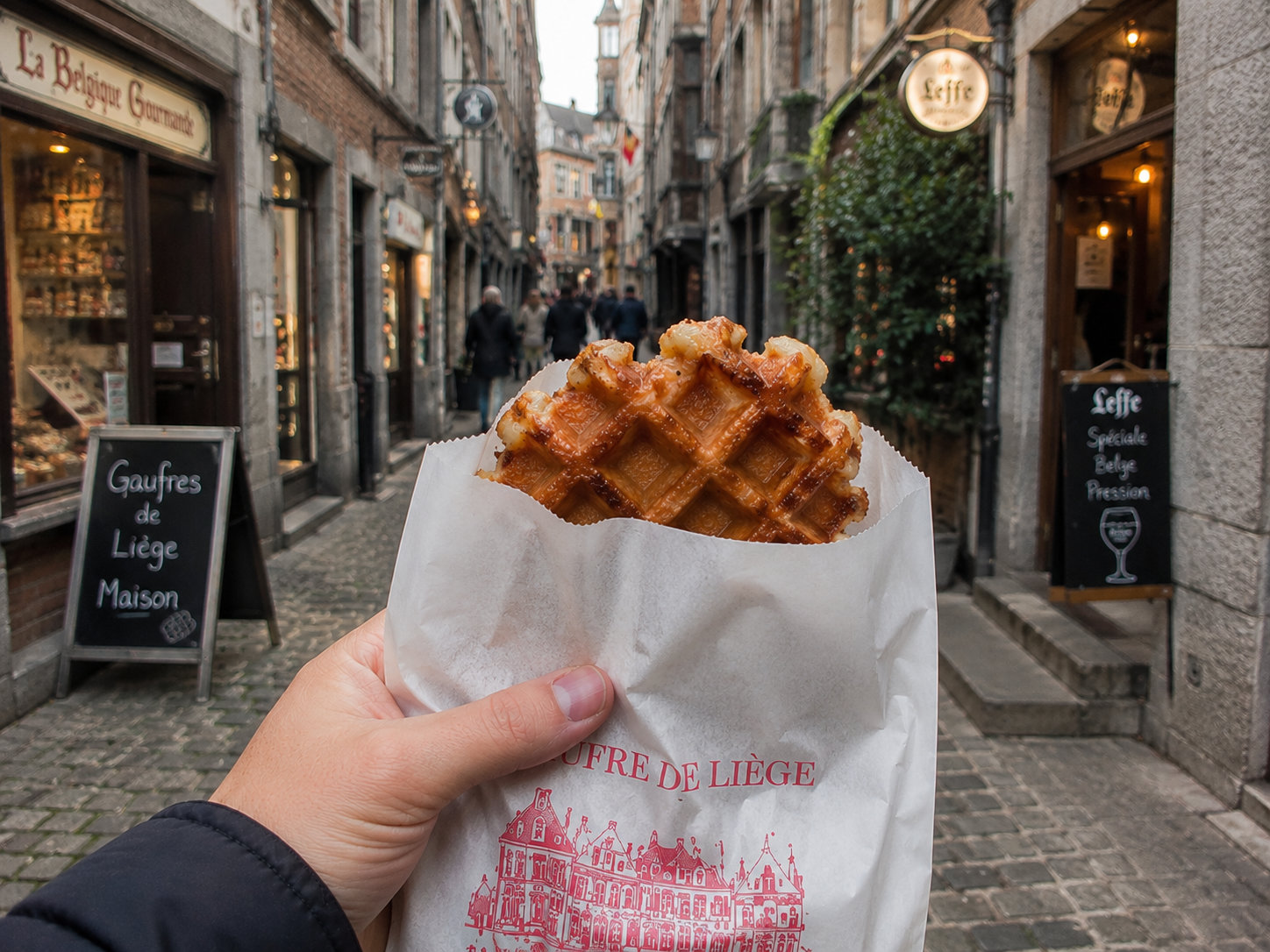
Belgium is fries, chocolate, beer. For decades, that was the country’s culinary trinity. But anyone scrolling through YouTube videos or Instagram reels about Belgium today quickly gets a different impression: apparently the entire country now consists of waffles. More specifically, Liège waffles.

Hardly any travel video from Brussels or Bruges begins without someone first holding a caramelized waffle up to the camera. Golden brown, glossy, heavy, often still steaming. Belgian waffles have become social media stars. But in reality, there is no single Belgian waffle. Belgium actually has several completely different waffle traditions.

Liège Waffles

Without question, the most famous of them at the moment is the Liège waffle. And honestly, the hype is not entirely undeserved. Liège waffles have very little in common with classic waffles. They are made from a heavy yeast dough with chunks of sugar folded into it, which caramelize on the outside during baking. The outside becomes both crispy and sticky, while the inside stays soft and almost brioche-like apart from the sugar crystals. These waffles rarely look perfectly. Some spread out unevenly, others are slightly too dark. That is exactly what makes them special.

The key point is this: a real Liège waffle does not actually need any toppings. It is already dessert enough on its own. In Belgium, people therefore often eat it plain, straight from the hand while walking down the street. Tourist shops love piling whipped cream, strawberries, and chocolate sauce on top, but the classic version comes without any decoration at all. Besides the standard vanilla version, traditional waffle stands also offer varieties with cinnamon in the dough.

Brussels Waffles

The Brussels waffle is almost the complete opposite. It looks nearly too perfect. Rectangular, even, with large deep pockets and a much lighter batter. While the Liège waffle is heavy and caramelized, the Brussels waffle feels elegant and airy. It contains less dense dough and comes across as crispier and drier.

Precisely because of its stable deep pockets, the Brussels waffle is ideal for toppings. Powdered sugar is the classic option, though of course mountains of whipped cream, fruit, and chocolate sauce also end up on top. Unlike the Liège waffle, the Brussels waffle almost seems to be waiting to be decorated. Perhaps that is exactly why it became the perfect tourist waffle – though it is increasingly overshadowed by the Liège waffle.

Fruit-filled Waffles

Much less well known are the filled Belgian fruit waffles mainly found in bakeries. At first glance, they look rather unimpressive: rectangular, very shallow pockets, boring. But take a bite: inside they are generously filled with cherries, plums, pineapple, vanilla cream, or chocolate cream. While tourists mostly search for the famous street waffles, these filled waffles belong more to Belgium’s quiet everyday food culture. They can also be found in supermarkets, usually near the refrigerated pastries. In particular, the waffles made by the company “Ô Bel Gaufre” from Aubel are very popular.

Butter / Biscuit Waffles

And then there is a fourth waffle world that receives far less attention: Flemish waffles. Brands like Jules Destrooper have almost cult status in Belgium. Thin butter waffles, crispy waffle biscuits, and nostalgic cookie tins have been just as much a part of coffee culture there for generations as beer and chocolate are part of everyday life. While tourists outside photograph caramelized Liège waffles, Belgians sit inside with coffee and biscuit tins.

Try them all

Perhaps that is exactly what makes Belgian waffles so fascinating: behind the Instagram hype lies not one single specialty, but an astonishingly diverse waffle culture. Some waffles are street food, others are desserts, and others are more like coffee biscuits. And that is precisely why it is worth not searching for only one famous waffle when visiting Belgium.

Note: Sorry, for once I’ve used an AI-generated image. I’m always so keen on waffles that I forget to take a photo.

A question that repeatedly causes confusion: How many inhabitants does Brussels have? The figures range from around 200,000 to 1,250,000 – from a small major city to a metropolis. The answer is simple, yet also confusing and quite curious. Typically Belgian, in fact:

The districts of Brussels have retained their independence and, to this day, remain individual municipalities, even though they have grown seamlessly into one continuous city. To come straight to the point: 1,250,000 inhabitants is “correct”.

City of Brussels

The City of Brussels (200,000 inhabitants) is, strictly speaking, just the city center, located within the inner ring (Pentagone), although it extends in three directions: to the north (including Laeken with the Atomium), to the east (the EU Quarter with the triumphal arch), and to the southeast (Avenue Louise to the city forest).

Brussels-Capital Region

The Brussels Region (1,250,000 inhabitants) is what one would normally call the city. It consists of the City of Brussels and 18 other municipalities which, as mentioned, are autonomous but also form a political unit with their own parliament.

Metropolitan Area

Beyond that, there is the Brussels Metropolitan Area, which, depending on how it is defined, has between 2 and 3 million inhabitants.

Brussels Municipalities

The cities within the “city” – the Brussels Region – include (with both their French and Dutch names):

  • Bruxelles / Brussel
  • Anderlecht
  • Auderghem / Oudergem
  • Berchem-Sainte-Agathe / Sint-Agatha-Berchem
  • Etterbeek
  • Evere
  • Forest / Vorst
  • Ganshoren
  • Ixelles / Elsene
  • Jette
  • Koekelberg
  • Molenbeek-Saint-Jean / Sint-Jans-Molenbeek
  • Saint-Gilles / Sint-Gillis
  • Saint-Josse-ten-Noode / Sint-Joost-ten-Node
  • Schaerbeek / Schaarbeek
  • Uccle / Ukkel
  • Watermael-Boitsfort / Watermaal-Bosvoorde
  • Woluwe-Saint-Lambert / Sint-Lambrechts-Woluwe
  • Woluwe-Saint-Pierre / Sint-Pieters-Woluwe

Curiosities

The cities naturally have their own postal codes (1000 to 1210) but share the same area code (02).

Responsibilities are organized differently: While the municipalities are independent, they share services such as waste disposal, fire protection, ambulance transport, and public transport. The 19 municipalities are, however, divided into six police zones. A merger is currently being planned.

As is typical for Brussels, the city boundaries are quirky in some places:

  • The famous Avenue Louise belongs to Brussels, even though it runs right through Ixelles. At its beginning, it also borders Saint-Gilles – meaning that by crossing the street, you pass through three different cities.
  • The wide boulevard between Place Louise and Porte de Namur is called Boulevard de Waterloo on one side (Brussels) and Avenue de la Toison d’Or on the other side (Ixelles).
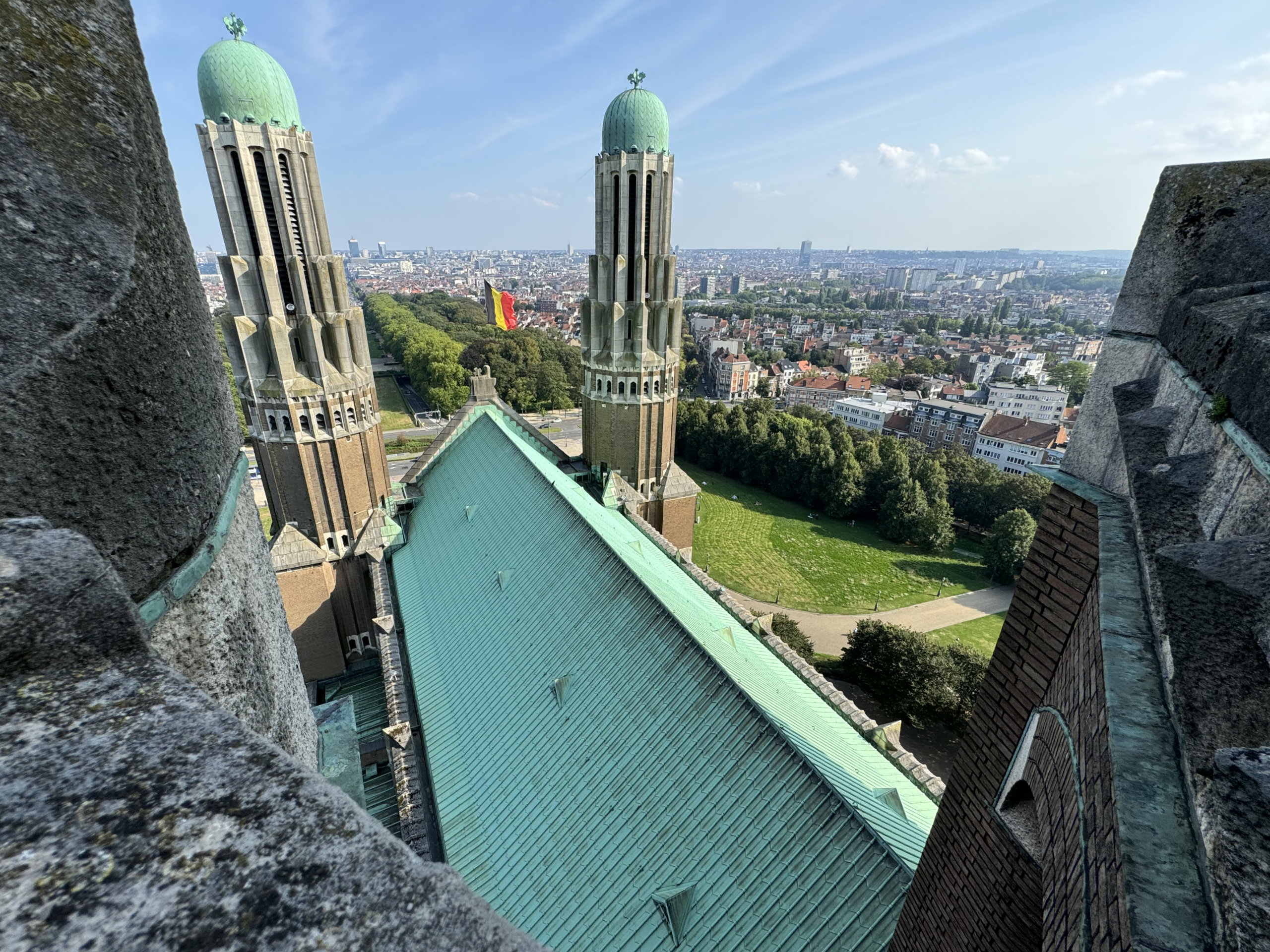
  • The city boundary between Koekelberg and Ganshoren runs right through the Basilica of Koekelberg.

By the way: The street signs in the cities of the Brussels Region look different and also include the name of the municipality (except on very old signs). However, this isn’t unusual in Belgium, even in villages.

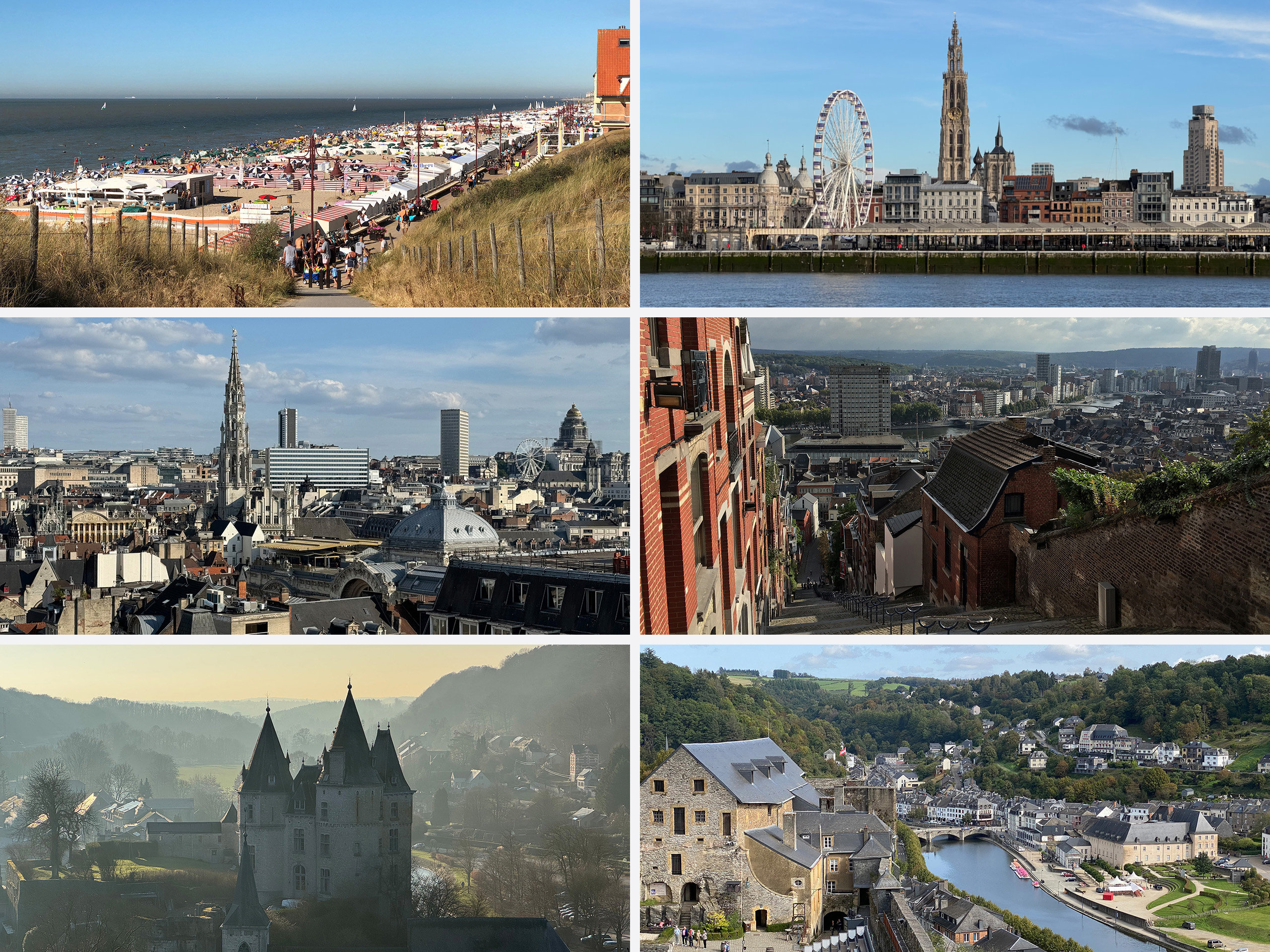
Large countries are characterized by their diverse landscapes and cities with distinct personalities. Belgium, however, is small: driving from north to south (Antwerp to Arlon) takes about 2.75 hours, while crossing from east to west (Eupen to Ostend) takes roughly 2.5 hours.

Despite its compact size of 30,000 square kilometers, Belgium offers an extraordinary variety: from fine sandy beaches along the North Sea coast, through the flat but water-rich region of Flanders, to the rolling hills of Wallonia, which are carved by deep river valleys.

Belgium has it all: vibrant metropolises like Brussels and Antwerp, museum-like art cities such as Bruges and Ghent, different types of coastal towns like Ostend and De Haan, thrilling industrial cities like Liège and Charleroi, and picturesque fortress towns like Dinant and Bouillon.

Of course, the diversity of Belgium is largely shaped by its two main regions: Flanders in the north and Wallonia in the south. Dutch (Belgian Dutch, which differs not only in the softer pronunciation) is spoken in Flanders, while French is the language in Wallonia. Near the German border, there is even a small German-speaking community, Ostbelgien (Eastern Belgium).

The appearance of Flanders and Wallonia is different, but with a few exceptions you can always recognise that you are in Belgium. Flanders does not look like the Netherlands, nor does Wallonia resemble France.

In fact, some neighboring cities in other countries exhibit Belgian influences, particularly Maastricht (Netherlands), Aachen (Germany), and Lille (France).

Now, let’s take a tour of seven cities. As a reference: driving through all seven city centers takes a total of 5 hours, covering a distance of 300 kilometers.

Ostend

With a population of 70,000, Ostend is the largest Belgian coastal city and serves as a major transport hub, connecting the main railway line (Cologne – Aachen -) Liège – Leuven – Brussels – Ghent – Bruges – Ostend with the coastal tramway. Despite its compact size, Ostend feels very metropolitan. In addition to its wide sandy beaches, the city offers a wealth of entertainment: excellent shopping, cozy cafés, outstanding restaurants, museums, a casino, and more. Tip: If Ostend feels too busy or built-up, take a 20-minute drive to the beautiful Belle Époque coastal town of De Haan.

Bruges

After a 30-minute drive, we reach Bruges. There’s little need to introduce this jewel of a city with 120,000 inhabitants: an absolutely perfect, living open-air museum with stunning churches, art treasures, picturesque squares, canals, and winding streets. While Bruges is very crowded in summer, it is very romantic in the other seasons.

Antwerp

After an 80-minute drive, we arrive in Antwerp (skipping over the must-see city of Ghent to keep this tour concise). Antwerp is a stunning Flemish metropolis of 530,000 residents, reknown for its huge port and its art and fashion scene. Lovers of culture, art, architecture, fashion and shopping will be delighted with what this city has to offer.

Brussels

An hour later, we reach Brussels, the bilingual heart of Belgium – an enclave within Flanders, close to the Walloon border. With a population of 1.2 million, Brussels is a metropolis that feels even larger and more urban due to its capital status. It boasts grand historical buildings, large churches, colossal palaces, royal museums, an awe-inspiring triumphal arch, the Atomium, Art Nouveau neighborhoods, and much more – everything a proud capital should have. However, Brussels is also affected by the decline seen in many European cities.

Charleroi

Shortly after leaving Brussels, we enter Wallonia. An hour later, we arrive in Charleroi, the largest city in Wallonia with 200,000 residents. Once a thriving industrial hub, Charleroi is not your typical tourist destination – it is, in most areas, run-down and even considered ugly, but that’s precisely what makes it famous. It attracts adventurous visitors interested in industrial history, urban art, and urban exploration.

Namur

Thirty minutes later, we find ourselves in a completely different world: the elegant Walloon capital of Namur, home to 110,000 people. Located at the confluence of the Meuse and Sambre rivers, Namur features a large fortress atop a hill, accessible by foot, cable car, or car. From there, visitors can enjoy beautiful views of the rivers, the historic city center, and the Meuse Valley. The city itself is filled with charming squares, inviting cafés, excellent restaurants, and stylish boutiques. It has a distinct southern European flair.

Dinant

Continuing through the lovely Meuse Valley, passing green mountains and fascinating rock formations, we reach our final destination: Dinant. This small town of 13,000 people is the postcard image of Wallonia: a river, a bridge, colorful houses, a grand church, and a massive rock formation crowned with a citadel. Tip: For those interested, a 20-minute drive along the Meuse River leads into France.

Belgium is a small country filled with historically significant sites. Currently, there are 79 UNESCO World Heritage sites in Belgium, with more being added. Here is an updated overview:

Grand Place in Brussels

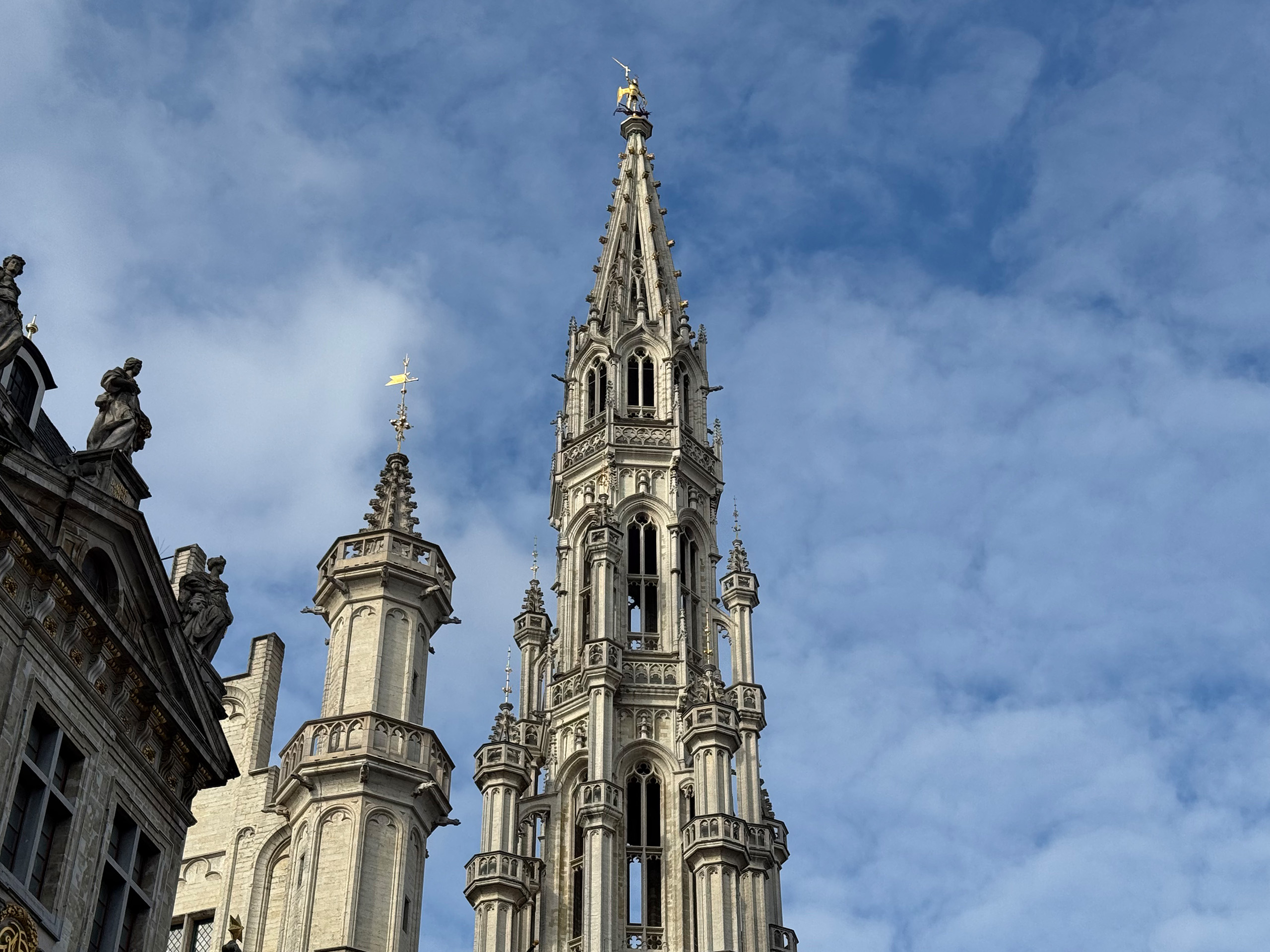
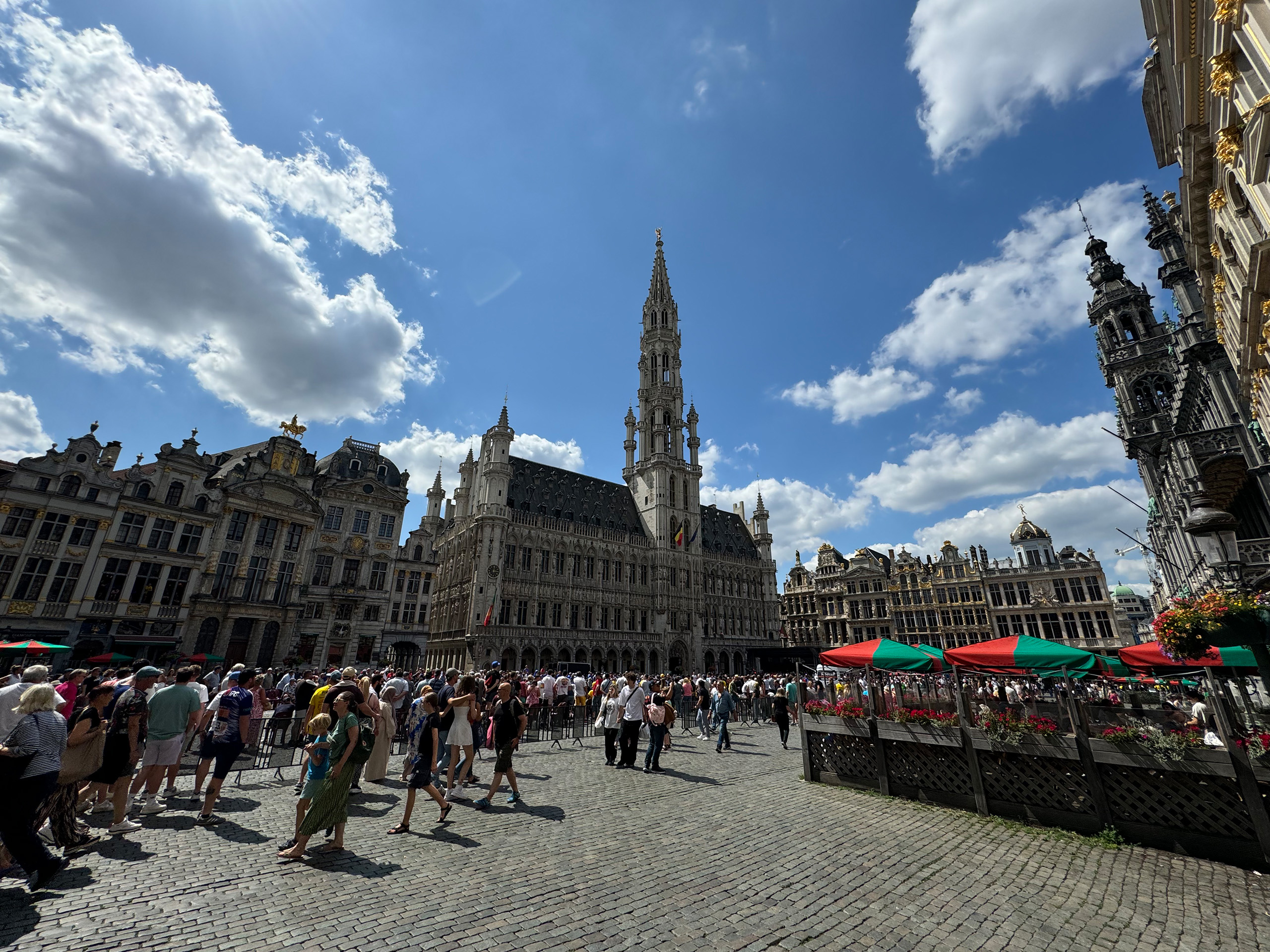
The Grand Place in Brussels was built in the 11th century and is now the historic center of Brussels. Originally, the square showcased a vibrant mix of styles from the 15th to the 17th centuries. After its destruction in 1695, the city council redesigned it with its current cohesive Baroque facade.

Major houses of the architect Victor Horta in Brussels

Victor Horta was a Belgian Art Nouveau architect who gained international acclaim in the late 19th century for the innovative designs of his buildings.

Stoclet House in Brussels

The Stoclet Palace is a private villa designed by architect Josef Hoffmann, built between 1905 and 1911 in Brussels for banker and art enthusiast Adolphe Stoclet. Considered Hoffmann’s masterpiece, the Stoclet Palace is one of the most sophisticated and luxurious private houses of the 20th century.

33 Belfries in Flanders and Wallonia

Belfries were primarily built during the Gothic period and are tall, slender bell towers typical of Belgian (and northern French) cities.

26 Beguinages in Flanders

The Beguines and Beghards were members of a Christian community who lived together in monastic-style communities. The 26 preserved beguinages in Flanders are examples of typical architectural ensembles.

Historic Center in Bruges

The medieval old town of Bruges, with its historic buildings, impressive churches, and numerous canals, has been almost entirely preserved.

Plantin-Moretus House in Antwerp

The museum in Antwerp traces its origins to a printing house founded in 1555 and is the only preserved printing workshop from the Renaissance and Baroque periods.

Cathedral of Notre-Dame in Tournai

Construction of the cathedral of Tournai began in 1110 in the Romanesque style. Subsequent modifications introduced early Gothic elements. Due to its architectural harmony and historical significance, it is considered one of the most beautiful cultural monuments in Western Europe.

4 Boat Lifts of the Canal du Centre

The Canal du Centre connects the Canal Nimy-Blaton-Péronnes with the Charleroi-Brussels Canal. The height difference along its course posed a significant challenge during its construction. The boat lifts, mostly preserved in their original condition, were built between 1882 and 1917 to overcome this obstacle.

4 Walloon Mining Sites

The World Heritage sites includes the coal mines of Grand-Hornu, Bois-du-Luc, Bois du Cazier, and Blegny in the Walloon coal basin, dating from the industrial revolution. These four mines stretch across Belgium from east to west and are among the best-preserved mines from the 19th and 20th centuries.

Neolithic Flint Mines of Spiennes in Mons

The flint mines at Spiennes in Mons date back to the Neolithic period and are the largest in Europe, with shafts approximately 15 meters deep.

And also:

Carnival of Binche

Marches of Entre-Sambre-et-Meuse

Processional Giants and Dragons

Traditional Games in Flanders

Shrimp Fishing on Horseback in Oostduinkerke

Belgium transforms into a winter wonderland during the Christmas season, enchanting visitors with its festive atmosphere, twinkling lights, and rich traditions. With its charming cities, world-renowned Christmas markets, and culinary delights, Belgium is the perfect destination to celebrate the magic of the holidays.

Tradition of Christmas Markets

In Belgium, Christmas markets can be found almost everywhere, some running from the end of November until after New Year’s (including opening on Christmas Eve), while others last only for a week or a weekend (mainly in small towns and villages).

The focus is clearly on stalls offering delicious food and drinks, festive decorations, lighting, ferris wheels, small rides, and ice skating. Depending on the region, you’ll find varying numbers of stalls selling Christmas items, decorations, and handicrafts – but the main attraction is definitely the food.

The largest and most beautiful Christmas markets are found in cities like Brussels, Antwerp, and Bruges, while the most picturesque ones are undoubtedly in the small towns of the Ardennes – especially if there is snow, which is not unlikely.

In Brussels, the Winter Wonders market is a highlight of the season. Located in the heart of the city, it stretches across the Grand Place, Bourse, Place Sainte-Catherine to the quays. This market boasts over 200 wooden chalets, a stunning light show projected onto the UNESCO-listed Grand Place, and a giant Ferris wheel offering panoramic views of the city. Visitors can shop for handmade gifts, taste waffles and mulled wine, or skate on the ice rink.

The Antwerp Christmas market is another must-visit. It spans multiple locations, including the historic Groenplaats and the banks of the river Scheldt. Here, visitors can enjoy a mix of artisan stalls, traditional Belgian beers, and unique souvenirs. Antwerp also offers a giant slide and themed rides for families.

In Bruges, the fairy-tale cityscape becomes even more magical during Christmas. The Markt square, surrounded by medieval architecture, is transformed into a festive hub with a cozy market and ice skating rink. The canals, illuminated with sparkling lights, add an extra touch of romance.

Belgian Christmas Cuisine

No trip to Belgium is complete without indulging in its famous culinary offerings. During the Christmas season, the markets provide an array of festive treats. Try Speculoos cookies, spiced and shaped into holiday motifs, or enjoy freshly made “Oliebollen”, deep-fried dough balls dusted with powdered sugar. Brussels and Liège waffles are also a must. Belgium’s legendary chocolate and pralines make perfect gifts and indulgent snacks, with many chocolatiers creating special Christmas editions.

Warm up with a cup of mulled wine or sample Belgian beers brewed specially for the season. Christmas beers, such as “Delirium Noël”, are rich, spiced, and perfect for winter evenings.

Holiday Traditions

Belgium’s Christmas celebrations also feature unique traditions. Saint Nicholas, known locally as Sinterklaas, plays a significant role, especially for children. Celebrated on December 6th, this figure brings gifts and treats, marking the start of the festive season.

On Christmas Eve, families gather for a traditional feast, often including dishes like roast turkey, venison, or seafood, followed by desserts such as “Bûche de Noël” (Yule log cake). Midnight Mass remains a cherished custom in many parts of the country.

A Season of Lights and Joy

From the dazzling light displays in Liège to the quaint charm of Ghent’s markets, every corner of Belgium sparkles with holiday cheer. Whether you’re exploring medieval towns, savoring festive flavors, or enjoying the warmth of local hospitality, Belgium offers an unforgettable Christmas experience!

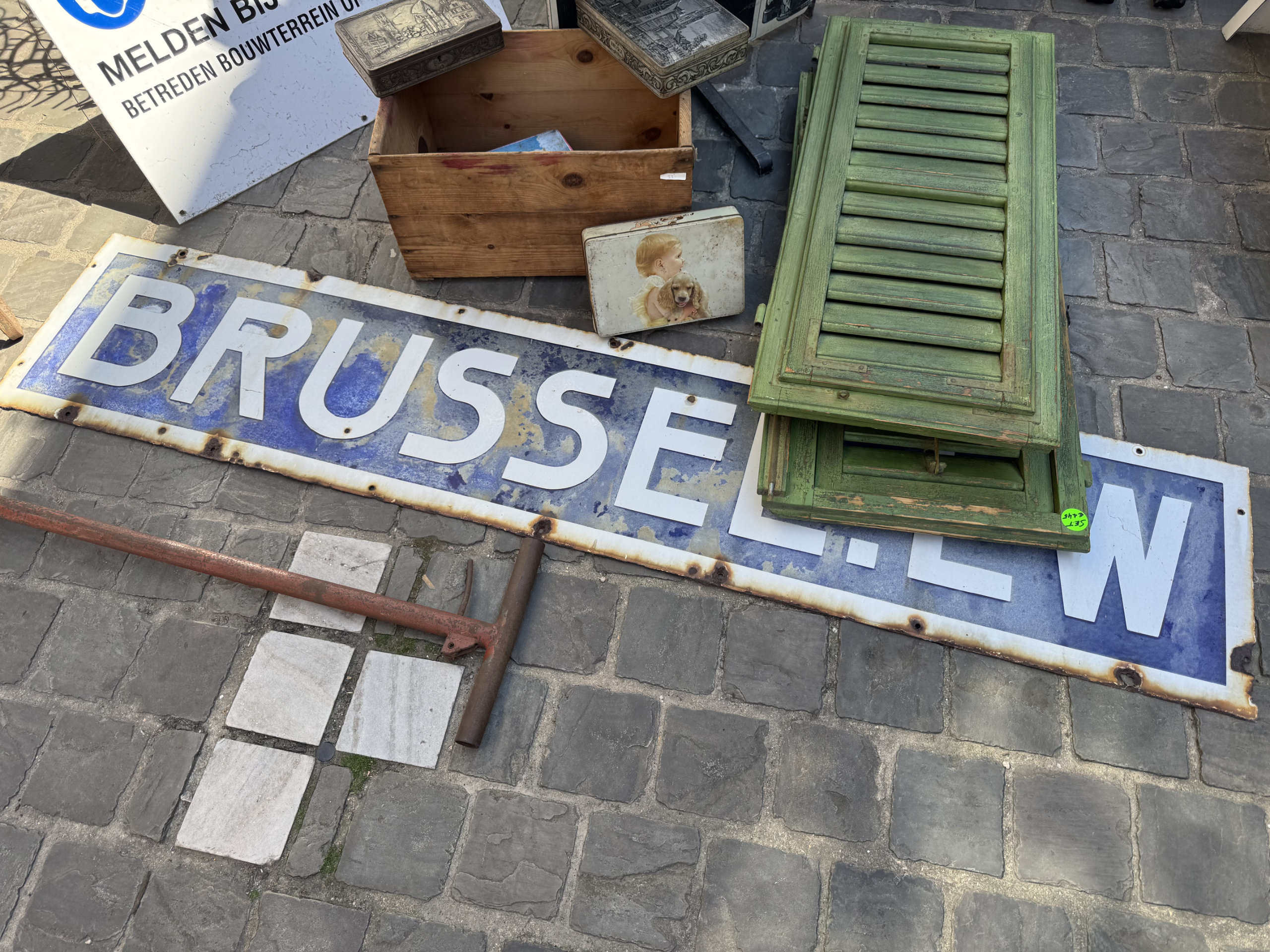
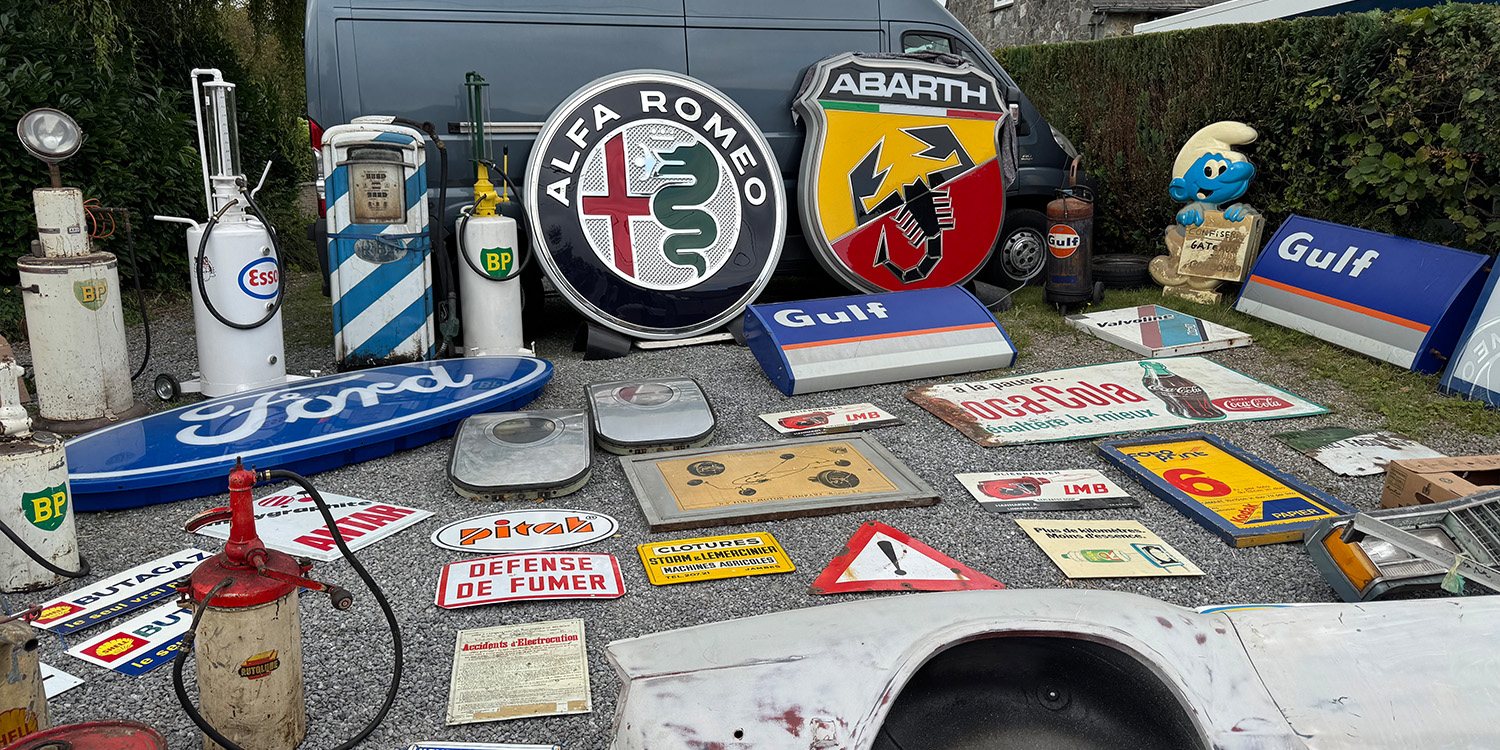
Belgium is a haven for lovers of flea markets. You can find just about everything imaginable, from the 18th century to the 1990s. At good, traditional flea markets, new items are not allowed, but there are plenty of unusual and rare things – that don’t have to be expensive. Markets are organised every weekend in countless locations. There is even a daily flea market in Brussels, while some others only take place once a year. Many visitors enjoy spending hours browsing through antiques, vintage clothing, books, records, furniture, and hidden treasures from different periods of history.

Here are my personal favourites:

Antiekmarkt Tongeren

every Sunday

Leopoldwal, Tongeren

The Antiques Market in Tongeren is the largest of its kind in the Benelux region. It takes place every Sunday from 7 AM to 1 PM, surrounding the Leopoldwal in the city center. Two large covered areas – the upper hall of the Julianus underground parking garage and the Eburons sports hall – provide additional shelter for the market.

You’ll find mostly classic antiques, furniture, collectibles, and curiosities. The market features around 350 stalls, 40 specialized antique shops, and charming cafés along the way.

Parking options are excellent: the Julianus underground parking garage (Clarissenstraat 41) is located right in the market area and is easily accessible.

Prices are generally moderate, which is why many antique dealers from neighboring countries shop here early in the morning.

Brocante du Marché Couvert de Battice

every Sunday

Rue des Forges les Eaux, Herve

The flea market in Battice, a district of Herve, is held in a fully covered hall that is normally used for cattle trading. It takes place every Sunday from 7 AM to 1 PM, after a thorough cleaning.

A wide variety of items are sold here: knick-knacks, decorations, furniture, collectibles, and tools. It’s not uncommon to discover awesome unusual rarities among the 200 stalls.

There’s a large parking lot directly in front of the hall.

Prices are very low, and the atmosphere is rough but friendly.

Brocante de Spa

every Sunday

Place Royale, Spa

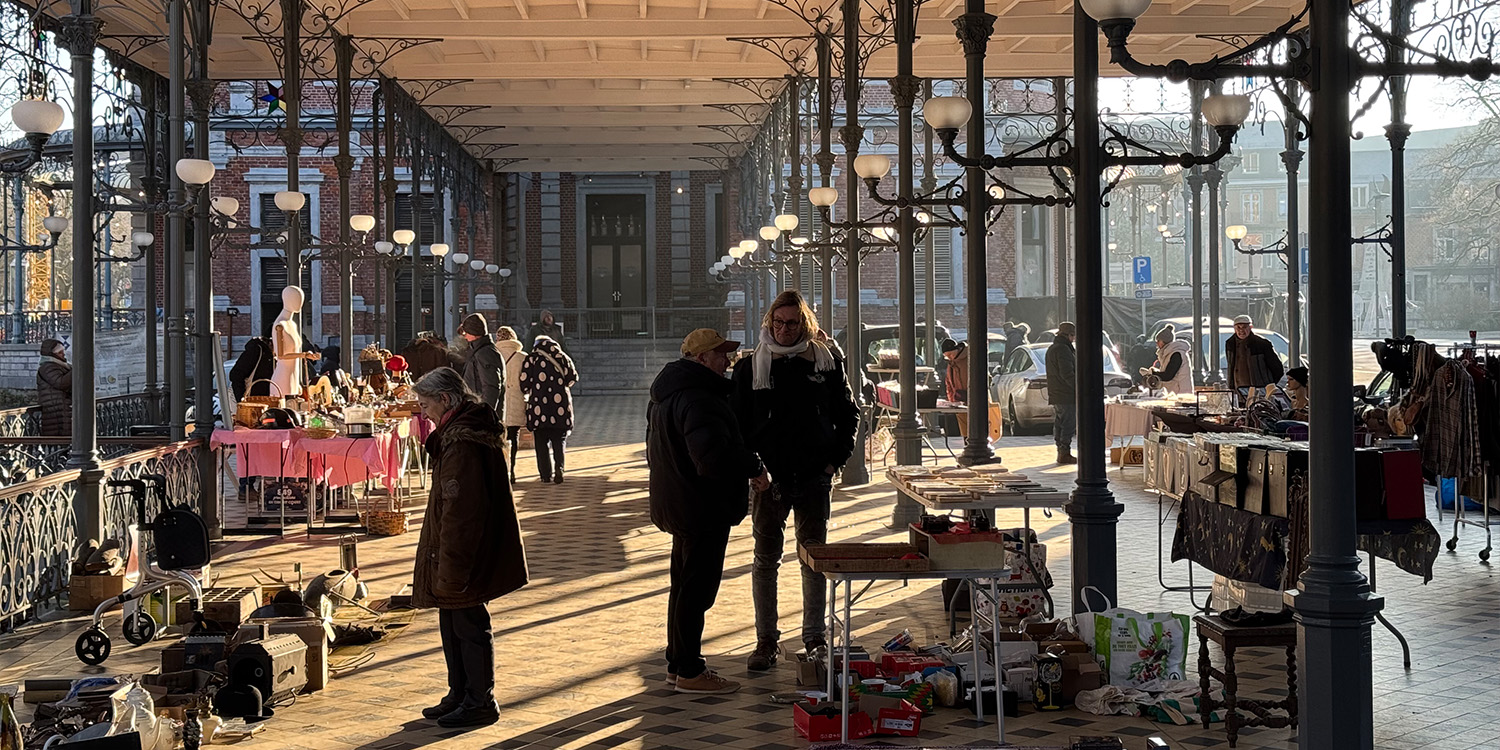
Traditionally held in a picturesque setting around the Galerie Léopold II in the center of Spa, this flea market has suffered due to the renovation of the gallery and the impact of COVID-19. Nevertheless, I include it here in the hope that it will soon regain its former size and charm.

The market takes place every Sunday from 7 AM to 2 PM. Items sold include second-hand goods and antiques. Parking can be challenging, prices are moderate.

Marché aux puces du Jeu de Balle, Brussels

every day

Place du Jeu de Balle, Brussels

This flea market is an absolute highlight and takes place daily from 9 AM to 2 PM at Place du Jeu de Balle, Brussels.

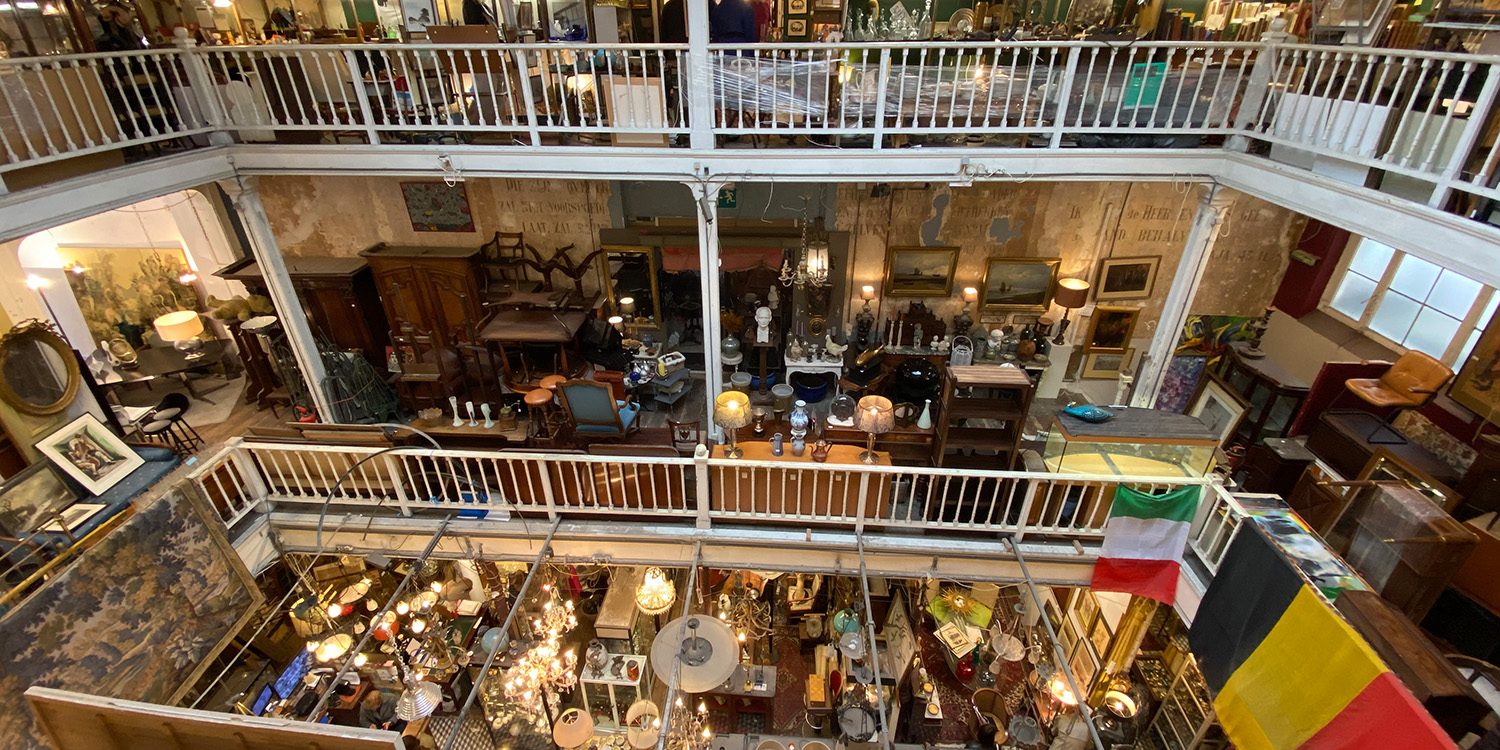
You’ll find second-hand goods and antiques at around 350 stalls. While the market itself has become very touristy, it’s situated in the heart of the fantastic antiques district between Marolles and Sablon. This area is home to dozens of antique shops – some small, some as large as department stores (see photo) – ranging from affordable to luxurious. You’ll also find rustic pubs and stylish cafés in the neighborhood.

For parking, the underground garage at Place Poelaert is ideal. From this elevated square, you can take an elevator down to the Marolles district.

Prices can be quite high. The market has become very touristy and the traders often come from countries where trading is done in a bazaar-like manner.

Ciney Puces

three times a year

Rue du Marché Couvert, Ciney

The flea and antique market in Ciney takes place three times a year over several days, from 10 AM to 6 PM.

It consists of three areas:

  1. The expo hall, where you’ll mainly find especially high-quality antiques such as statues, furniture, paintings, jewelry, and glassware.
  2. On the esplanade, there’s a small market offering a fairly mixed but high-quality range of goods.
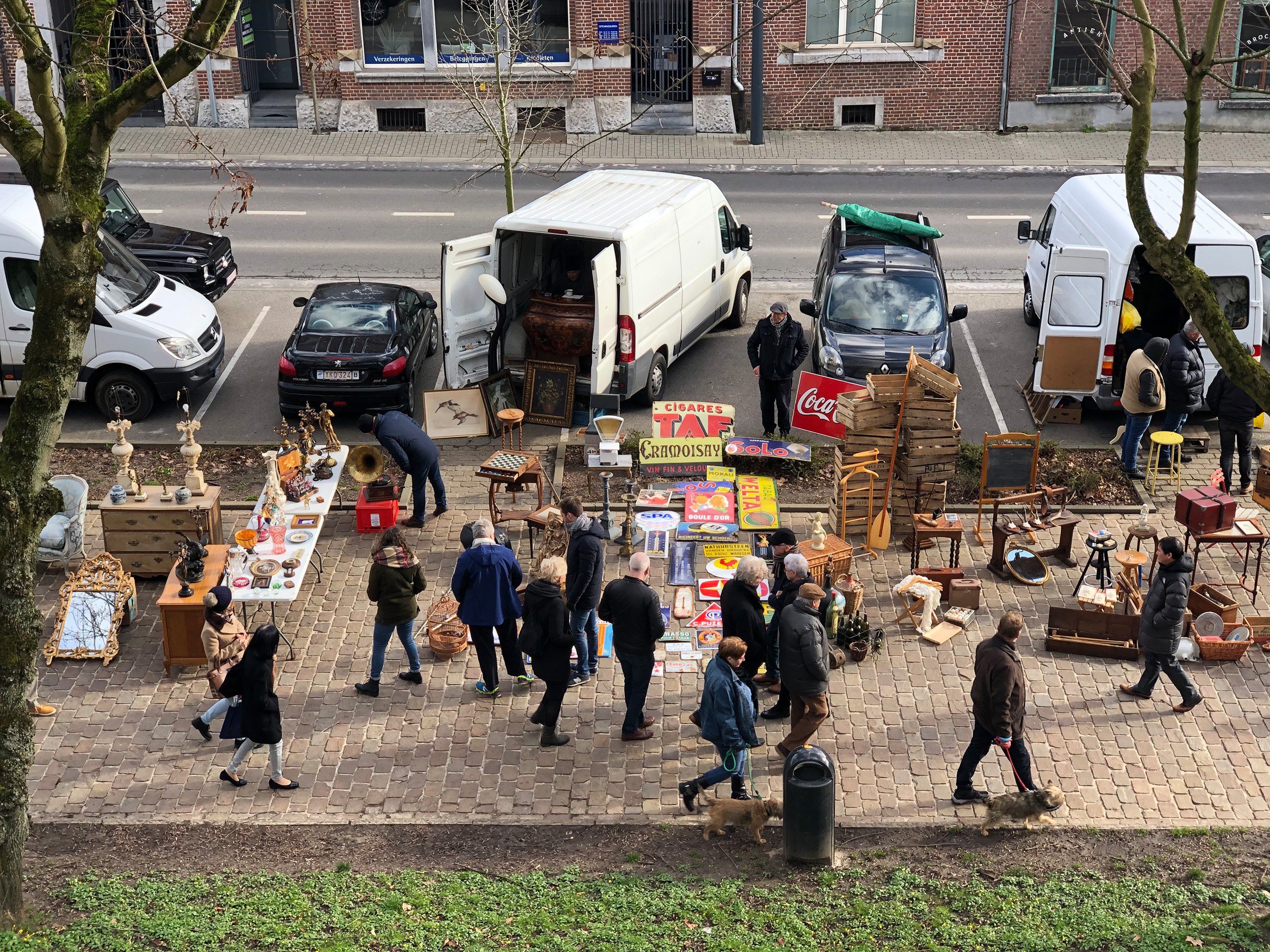
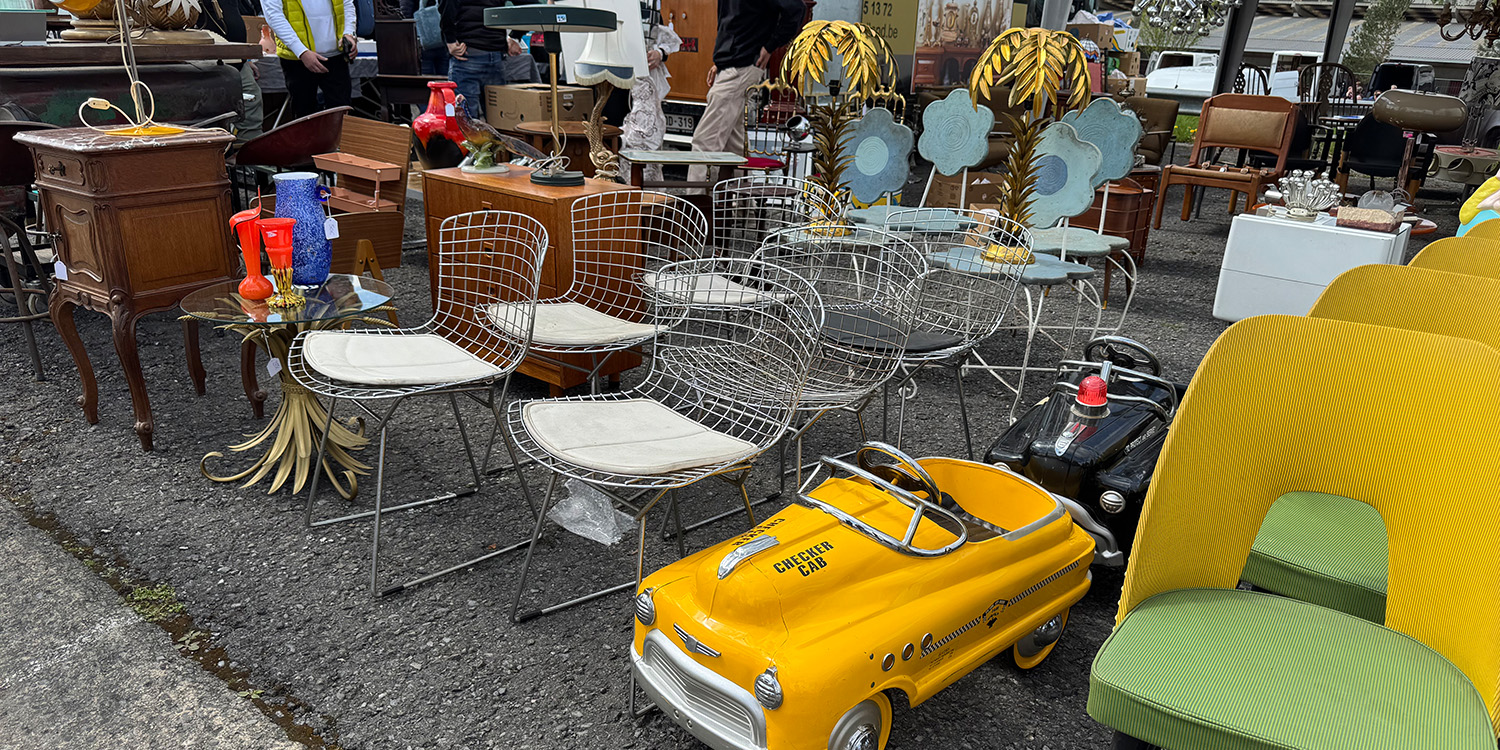
  3. What I find most interesting, however, is the “Déballage” on the surrounding car parks: On the first day, which is always a Friday, at exactly 2 PM, the gates open, the dealers rush to their vehicles, and begin unpacking their goods. Buyers wander among them, peeking into the transporters. After about 30 minutes, everything is set up, and the market continues until 6 PM. On the following days, there may be significantly fewer stalls, so the main day is Friday. You will find a wide range of high-quality goods, but the focus is on decoration and furnishings.

In total, there are around 500 stalls. Admission to the grounds is subject to a fee, but there is more than enough free parking available. Prices range from moderate to high, but are mostly reasonable.

Marché aux Puces du Vieil Arlon

first Sunday of every month from March to October

Grand Place, Arlon

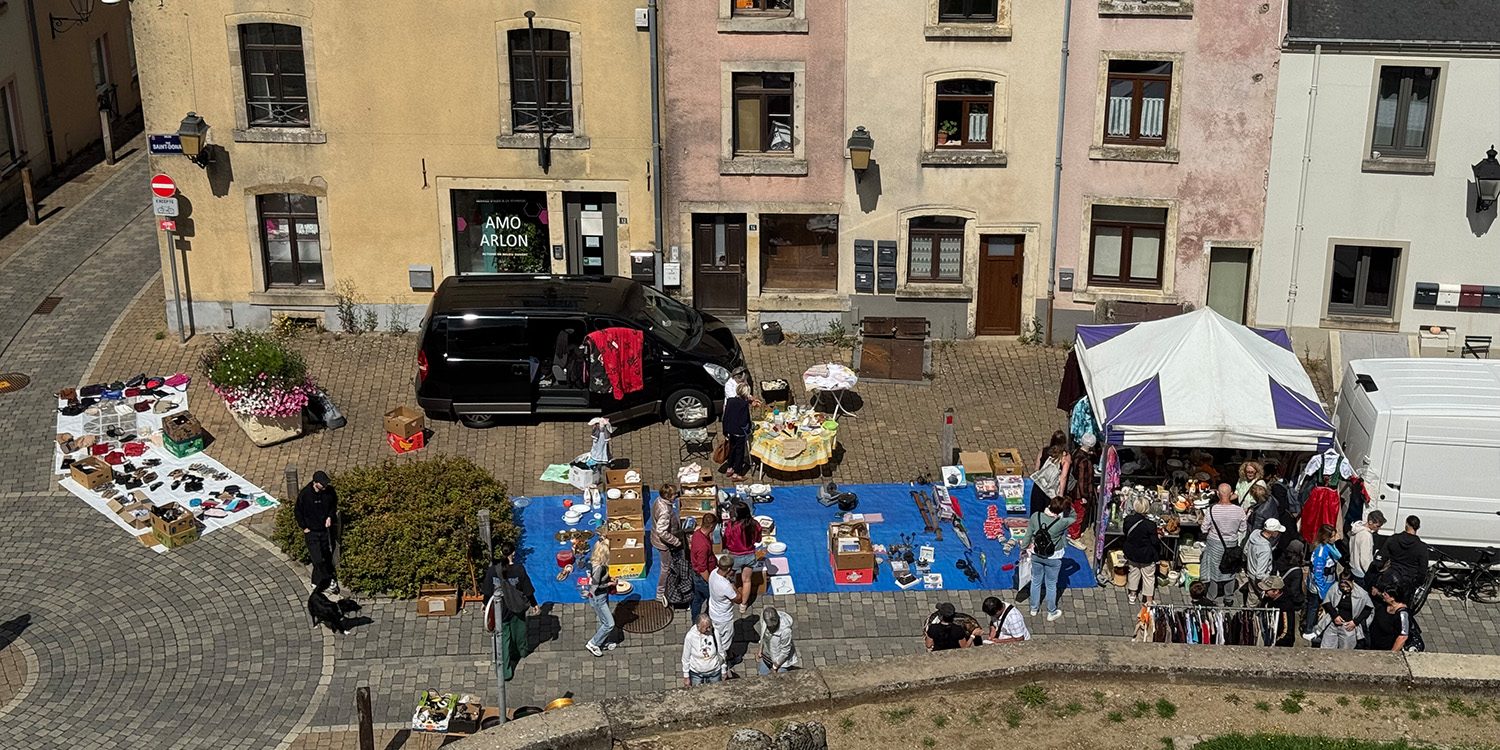
The flea market in Arlon takes place on the first Sunday of every month from March to October in the town center, and can be quite large in good weather.

There is a colorful and varied selection on offer, including goods for specialized collectors as well as true highlights.

A well-maintained underground parking garage is located beneath Place Léopold.

Prices are generally very moderate.

Brocante de Temploux

annually in August

Rue Arsène Grosjean, Namur

The flea market in Temploux (near Namur) is highly esteemed among collectors and takes place once a year in August (Saturday and Sunday) in the streets of the village.

The market focuses primarily on collectibles, with many specialized stalls. There are around 1,200 stalls spread over a 6-kilometer route, along with food stands and a lively program, including fireworks.

Plenty of parking is available, mostly on fields prepared by local farmers.

Prices are generally moderate to low.

The market can get extremely crowded, especially in good weather, but it is exceptionally well-organized, from parking to restrooms. Half the village pitches in to help!

Temploux is my favourite. Unfortunately, the market only takes place once a year.

Tips for Belgian Flea Markets

Dates: Always check online in advance. Even weekly markets can occasionally be cancelled, for example due to another event or a public holiday.

Offer / Attendance: Some markets are covered, but most are only partially or not at all. Light, intermittent rain is usually not a problem, but strong wind or unpleasantly cold weather can significantly reduce the number of stalls. Markets also tend to be quieter on holidays or during school breaks.

Opening hours: Most markets start earlier than the official time, and sellers often begin packing up before the listed closing time. If you’re looking for something specific, it’s best to arrive early.

Language: Depending on the region, Dutch or French – often English as well, or simply some hand gestures.

Bargaining: Prices are generally fair and realistic, but a polite and brief attempt to negotiate 10-20% off is usually acceptable – even if items are labeled with price tags. (Brussels is an exception: prices there often start high, and bargaining is more like a bazaar.) Don’t haggle if the price is already very good. Sometimes sellers will kindly refuse to negotiate if they’ve already offered their best price. In antique shops, bargaining is uncommon.

Payment: Bring enough cash, or locate a nearby ATM.

Bonus tips: Always ask for the price if you find something even halfway interesting – it’s often much lower than you’d expect. If you find something truly great, pick it up or talk to the seller right away – another interested buyer might appear out of nowhere.

You can find more markets and dates here.