
Belgium is a country with a long railway tradition. In 1835, the first railway line on the European continent opened between Brussels and Mechelen. Almost two centuries later, the history of Belgium’s railways can still be traced particularly well through its stations.
The most interesting stations are not necessarily the largest or the most beautiful. Some impress with their architecture, others with their location or an unusual technical solution. Antwerp combines a historic railway cathedral with a modern underground through station. In Brussels, one of the country’s most important stations lies almost invisibly beneath the city center. Liège and Mons showcase two very different designs by Santiago Calatrava, while in Oostende you practically step off the train straight into the harbour and seaside setting.
These five stations are, in my view, the most interesting in Belgium. They are joined by five more that are also well worth a closer look.
Antwerpen-Centraal – the Railway Cathedral
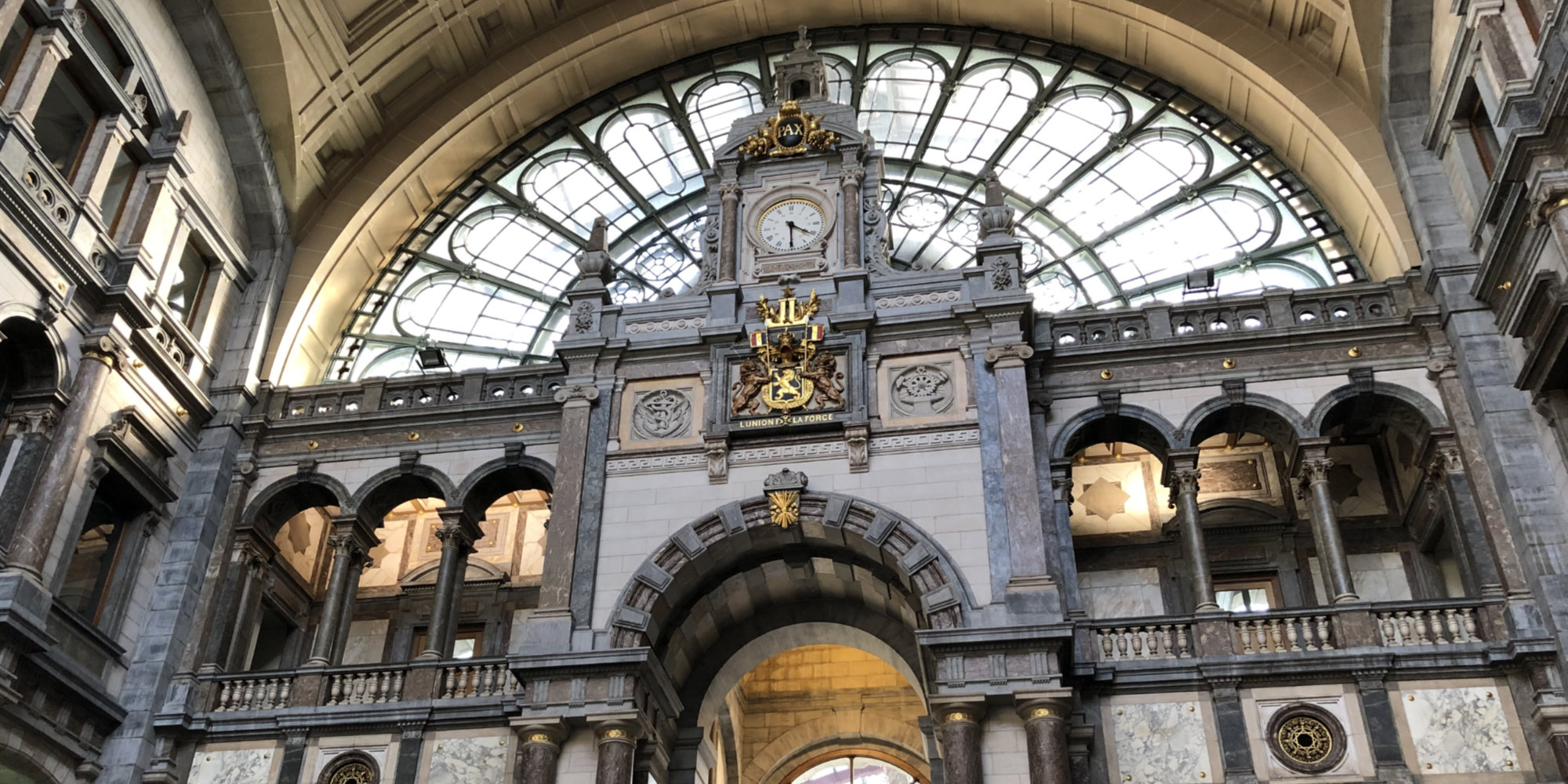
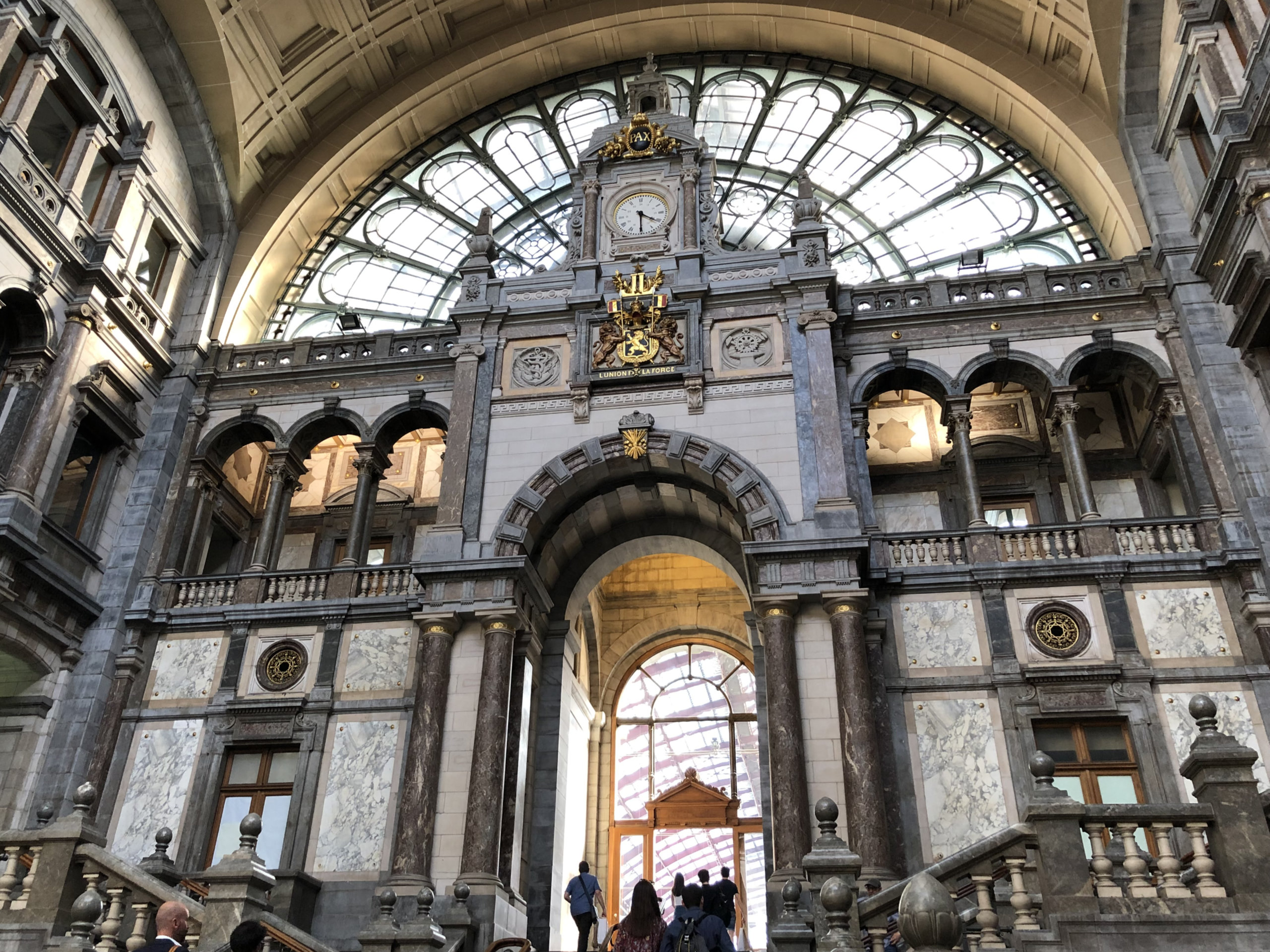
In the case of Antwerpen-Centraal, the nickname is, for once, no exaggeration: “Spoorwegkathedraal”, or railway cathedral, suits this station better than almost any other in Europe.
The grand entrance and former ticket hall already feels more like a prestigious palace than a transport building. Above it rises a monumental domed structure with large expanses of glass. Staircases, galleries, columns, natural stone, and an enormous wealth of historicist detail make it easy to forget that the building was originally intended above all to serve a very practical purpose. The station building, designed by Louis Delacenserie, was constructed around the turn of the 20th century and completed in 1905.
Behind it lies the historic train shed with its steel-and-glass construction. It was largely designed by engineer Clément Van Bogaert and entered service as early as 1898. Its impact comes above all from its height, its elegant arches, and the contrast with the stone station building. However, you should not expect a gigantic train hall with endless platforms: compared with the monumental appearance of the station, the historic track area feels surprisingly compact.
The truly remarkable part lies beneath it. Antwerpen-Centraal was originally a terminus. Between 1998 and 2007, the new north-south rail link was built beneath the historic station and parts of the city. It transformed Antwerpen-Centraal into a through station and made it possible for trains – including international high-speed services toward the Netherlands – to run directly beneath the old station.
To achieve this, the station was extended deep underground. If you remain upstairs in the historic hall, it is easy to overlook this. Only when you look into the central open space do you realize that several additional levels extend beneath the Belle Époque architecture and that the railway continues far below the old station.
That is what makes Antwerpen-Centraal so extraordinary: the historic station was not replaced by a modern new building. Instead, an entire second railway world was constructed beneath it. The cathedral above, the modern through station below – it is hard to imagine a more impressive way of illustrating the development of the railway.
Bruxelles-Central / Brussel-Centraal – the Station beneath the City
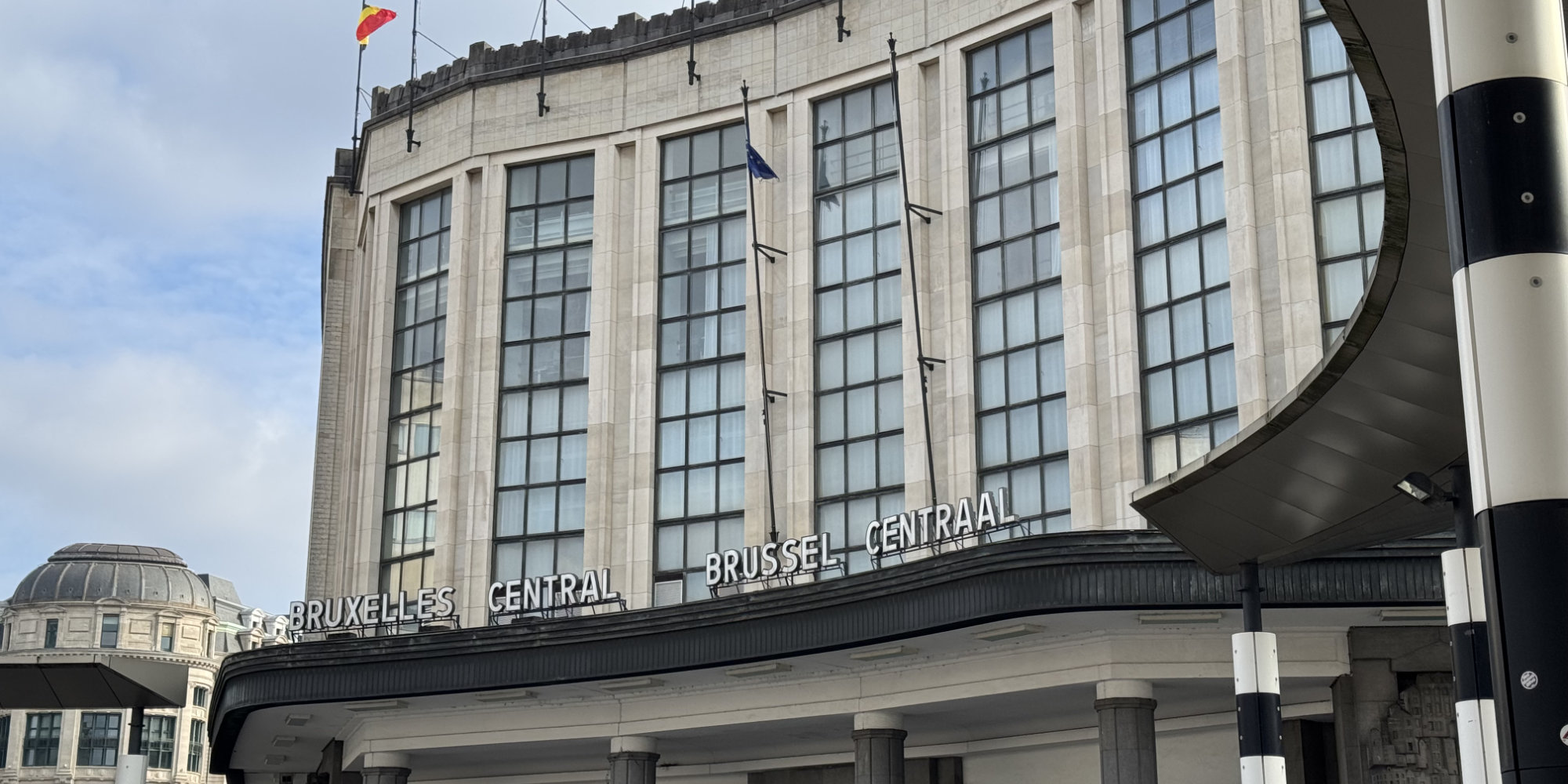
Bruxelles-Central is almost the opposite of Antwerp. The station is located in one of the most central places in Belgium – and yet from the outside it appears surprisingly inconspicuous.
It does not stand independently on a large station square but is embedded in a dense network of streets and urban blocks. The Grand Place, Mont des Arts, and the Cathedral of St. Michael and St. Gudula are only a few steps away. It is hard to imagine a better location for a railway station in a European capital.
Architecture enthusiasts should nevertheless take a closer look, because the building is associated with one of Belgium’s most important architects: Victor Horta. He was commissioned to design the station as early as 1910 and developed various plans over the following years. Construction did not begin until 1937. Maxime Brunfaut later continued the work, and Bruxelles-Central opened in 1952. The station is therefore one of Horta’s major late projects, although stylistically it has little in common with his famous Art Nouveau buildings.
Even more interesting is the history of the railway beneath it. Brussels’ large stations to the north and south of the city were originally termini. There was no efficient cross-city rail link connecting the two. Work on what is now the North-South Connection began in 1911, came to a halt during the First World War, resumed in 1936, and was finally completed in 1952.
The project was one of the great infrastructure schemes of 20th-century and reshaped parts of the urban fabric along the eastern edge of the historic center. What matters most, however, is the result: trains can now cross the capital from north to south. International services arriving from different directions can continue through Brussels rather than terminating there.
Surprisingly little of this importance can be felt on the platforms. Underground, Bruxelles-Central is decidedly functional. The platforms are well maintained but architecturally hardly spectacular; dark wall surfaces and the tunnel-like character dominate the atmosphere.
That contrast is what makes the station interesting. Above, you stand in the middle of Brussels’ historic center. Below, one of the country’s most important railway corridors runs beneath your feet. It is a major station that hides almost entirely under the city.
Liège-Guillemins – Calatrava’s grand Railway Sculpture
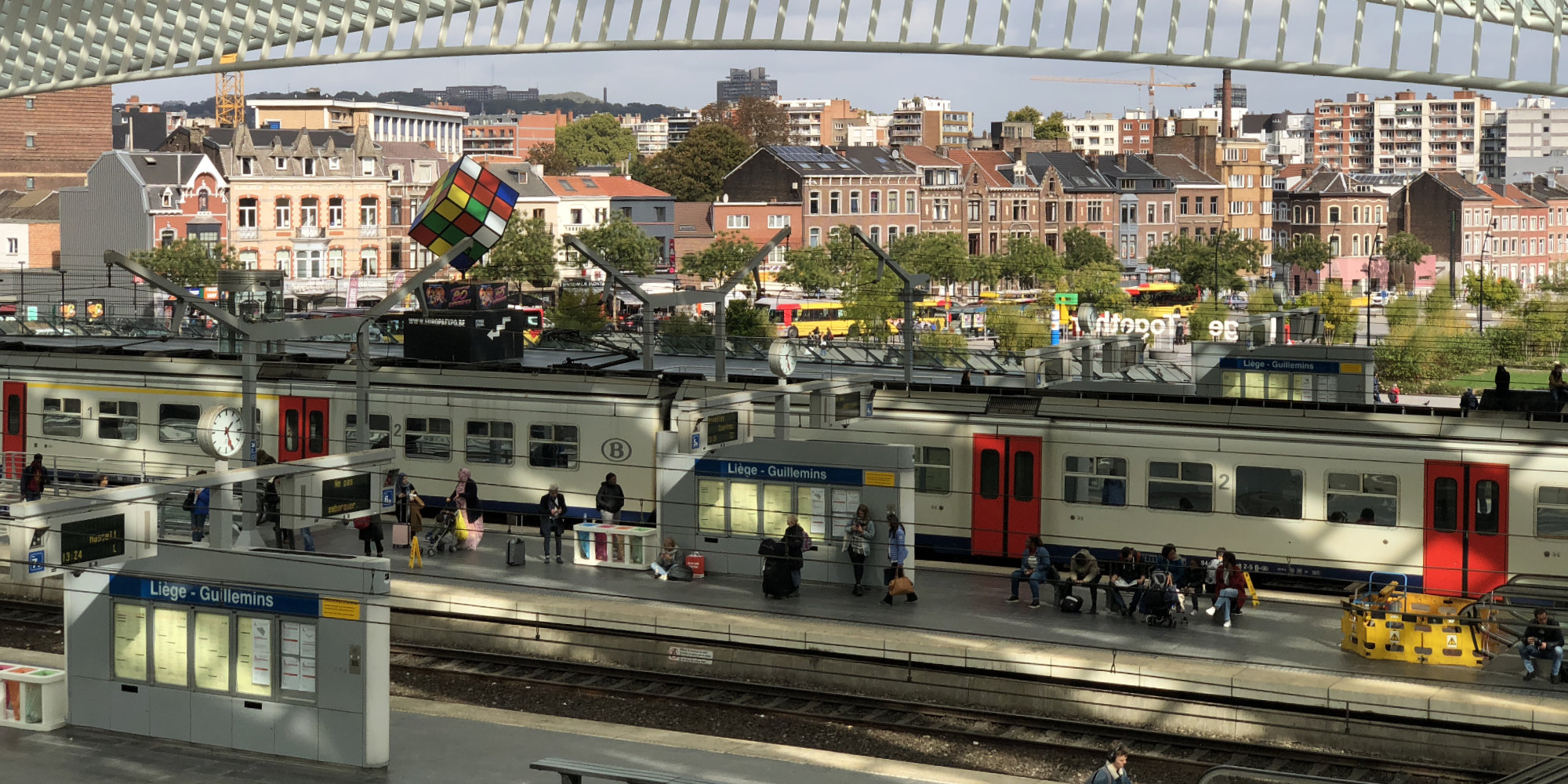
Liège-Guillemins does not hide. Even as the train approaches the station, it becomes clear that the architecture itself is intended to be an event.
The present station was designed by Santiago Calatrava. The Spanish-Swiss architect and engineer was commissioned to create the new station in the 1990s, and it opened in 2009. It replaced a functionalist post-war building and was also intended to provide Liège with a station worthy of the European high-speed rail network.
Calatrava abandoned the traditional idea of a station with a clearly separate entrance building in front of the tracks. Instead, the entire complex is unified by a vast structure of white concrete, steel, and glass. The sweeping roof rises above the platforms and appears to stretch across almost the entire station. Depending on the angle, the recurring white ribs and arches evoke a skeleton, a wing, or an enormous modern vault.
The complex nevertheless has a clearly defined city-facing side. A spacious esplanade opens up in front of the station, giving the building the distance it needs. It is from here, in particular, that the architecture makes its strongest impression.
Inside, Liège-Guillemins is a station in which structure and architecture are almost impossible to separate. There is no historic ticket hall leading into a separate train shed. The structure above the tracks is itself the station’s great spatial experience.
Since 2025, the station has also been connected to the tram network. Liège’s new tram line serves Guillemins and links the station with important parts of the city center and other neighborhoods. This has further strengthened the station’s role as a public transport hub.
Liège-Guillemins is divisive. Anyone who loves historic stations with dark natural stone, wood, and iron may not immediately feel at home here. But as a modern railway station, the complex is uncompromising. Calatrava did not simply place a roof over the tracks, he turned the entire station into a monumental sculpture visible from afar.
Mons – the new Station above the Tracks
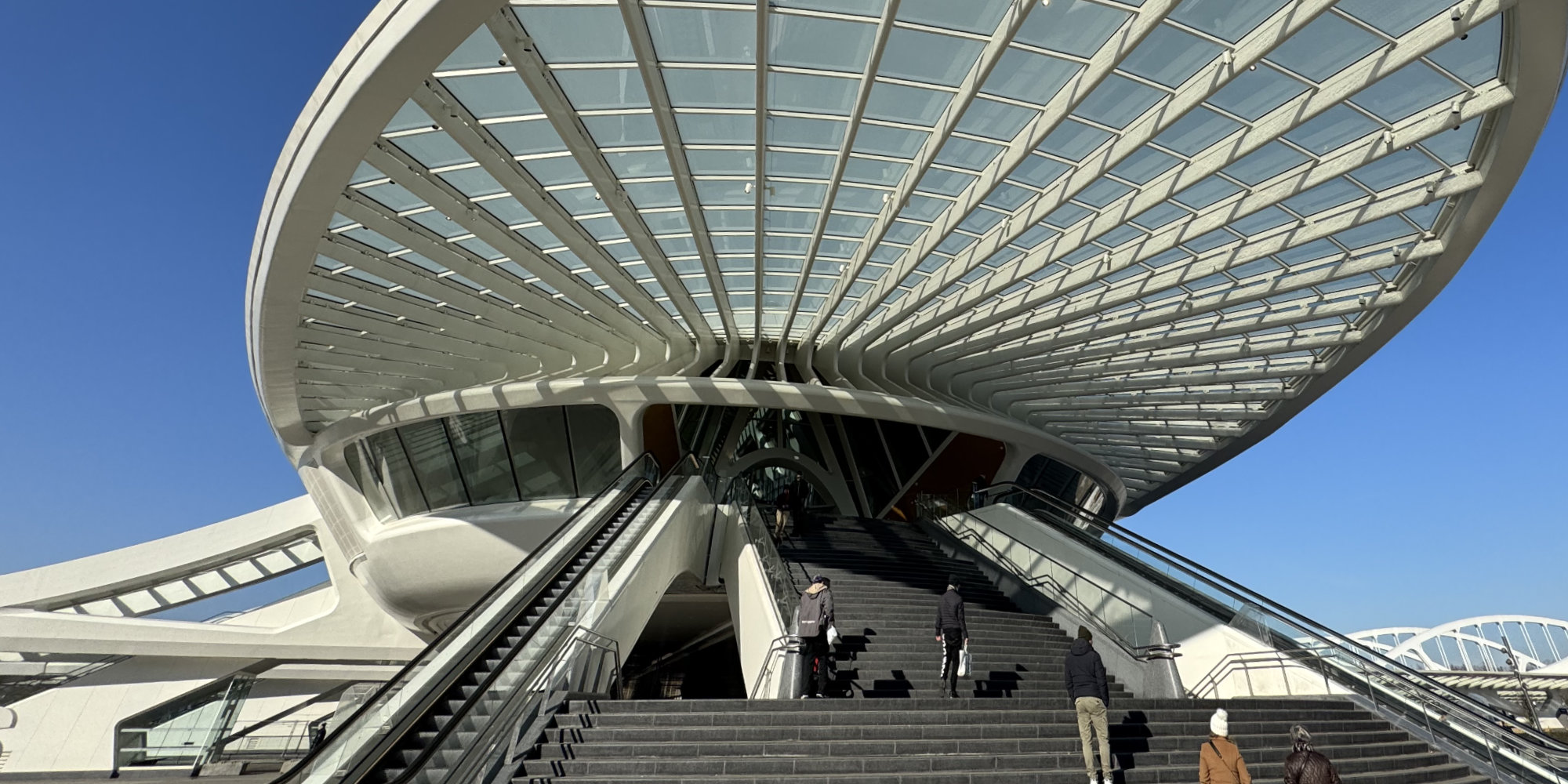
Mons also unmistakably bears Calatrava’s signature. Even so, the station is not a repetition of Liège-Guillemins.
Whereas in Liège the large roof over the platforms dominates the experience, the spatial center of Mons lies above the tracks. A large covered passage crosses the railway lines. From there, passengers descend to the platforms, while the structure simultaneously connects the two sides of the station. On one side lies Place Léopold toward the historic center; on the other are Place des Congrès and the Grands-Prés area.
This urban connection should not be exaggerated, however. The two sides of the station are by no means equally relevant to visitors. For tourists, the side facing the historic center of Mons is clearly the interesting one. The bridge structure is remarkable primarily because Calatrava has organized the station itself above the railway tracks.
The new station opened for regular service in December 2024. This makes Mons by far the newest station in this selection. Its development stretched over many years, and the finished building is correspondingly large in scale.
Typical Calatrava motifs can be seen everywhere: white ribs, large glass surfaces, sweeping curves, and a structure that feels both technical and almost organic. The covered passage is not simply a walkway but the station’s central public space.
Mons becomes particularly interesting when compared with Liège. Both stations were designed by the same architect and unmistakably speak the same formal language. Yet the experience of them is completely different. In Liège, you stand beneath a vast open hall. In Mons, you first move above the railway and look down.
Having two Calatrava stations in the top five almost becomes a theme in itself. They show how differently the same architect can respond to two railway sites.
Oostende – Terminus by the Sea
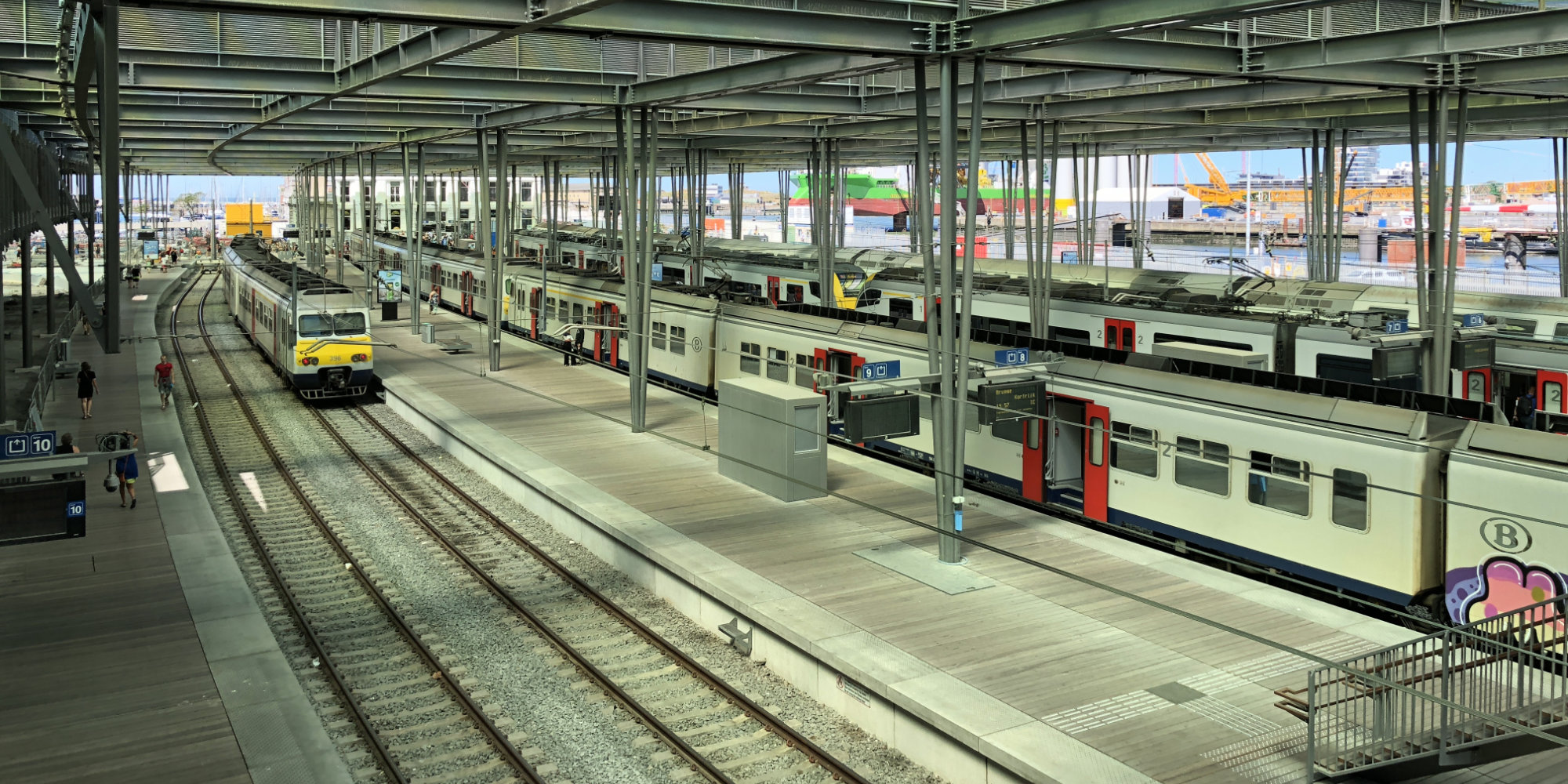
Oostende appears on this list less because of a single spectacular architectural feature than because of the overall impression. Here, the railway station, harbour, coastal city, and local public transport come together in an unusually harmonious way.
The historic station building was constructed between 1907 and 1913 to designs by Belgian State Railways architects Otten and Seulen. The former Oostende-Kaai station was deliberately designed as both a maritime station and a terminus. Rail travel was closely linked to shipping across the English Channel here – Oostende was one of Belgium’s major gateways to Great Britain for decades.
Today, the historic complex gains much of its special appeal from its modern canopy. The large roof by Dietmar Feichtinger Architectes covers not only parts of the railway station but also integrates the coastal tram and other transport functions into a shared space. Translucent polycarbonate panels supported by a steel structure allow plenty of light to enter, while their varying colors create a surprisingly colorful atmosphere depending on the weather and time of day.
The connection to the Kusttram is particularly convenient. Belgium’s coastal tram stops directly at Oostende station, and transferring between train and tram takes place practically within the same transport complex. Anyone continuing along the coast can step off the train and almost immediately board a tram.
For me, however, the real highlight comes when leaving the station. An unusually spacious urban setting opens up in front of you. On one side are the marina, water, and sailing boats. Nearby rises the neo-Gothic Sint-Petrus-en-Pauluskerk, followed by harbour basins and the maritime world of Oostende. The sea itself is still a short walk away, but the arrival already feels unmistakably coastal.
Oostende may therefore be the most atmospheric station on this list. You do not simply arrive in a city. You arrive on the Belgian coast – and the station, tram, and harbour tell you that within the first few minutes.
Gent-Sint-Pieters – the Candidate that just missed out
Gent-Sint-Pieters would be my clear number six. The historic station building was designed by Louis Cloquet and constructed in the run-up to the 1913 Ghent World’s Fair. Cloquet conceived the station as a prestigious gateway to the city, and that is exactly how it still feels today.
The interior is particularly worth seeing. In the hall, sgraffiti depicting Belgian cities recall the station’s original role in presenting international visitors to the World’s Fair with an impressive image of the country. The distinctive tower and long historic façade also give Gent-Sint-Pieters a strong and recognizable identity.
The platform side, however, does not entirely live up to this grand presentation. This illustrates a phenomenon encountered more than once at Belgian railway stations: the historic station building can be exceptionally ornate, while the actual platforms remain far more functional.
Nevertheless, Gent-Sint-Pieters is without doubt one of Belgium’s most important stations from both an architectural and historical perspective – and the first candidate that has to be left out of a top five.
Namur – historic Station and Buses on the Roof
Namur should not be reduced to its unusual bus station. The historic station building on Place de la Station is already worth seeing in its own right.
The present building was designed by A. P. J. Lambeau and inaugurated in 1864. It is a monumental station in a French-influenced Neoclassical style. With its long symmetrical façade and pale stone, it forms an exceptionally representative backdrop to the station square.
The real curiosity, however, lies behind and above it. Since 2023, the central bus station has been located on an upper level built over the railway tracks. Buses reach it via dedicated access roads, while direct routes connect it with both the railway station and the city.
Namur thus combines a historic 19th-century railway station with a distinctly modern approach to integrating different modes of transport in a densely built-up city center. Rail passengers, buses, and pedestrians are organized across different levels.
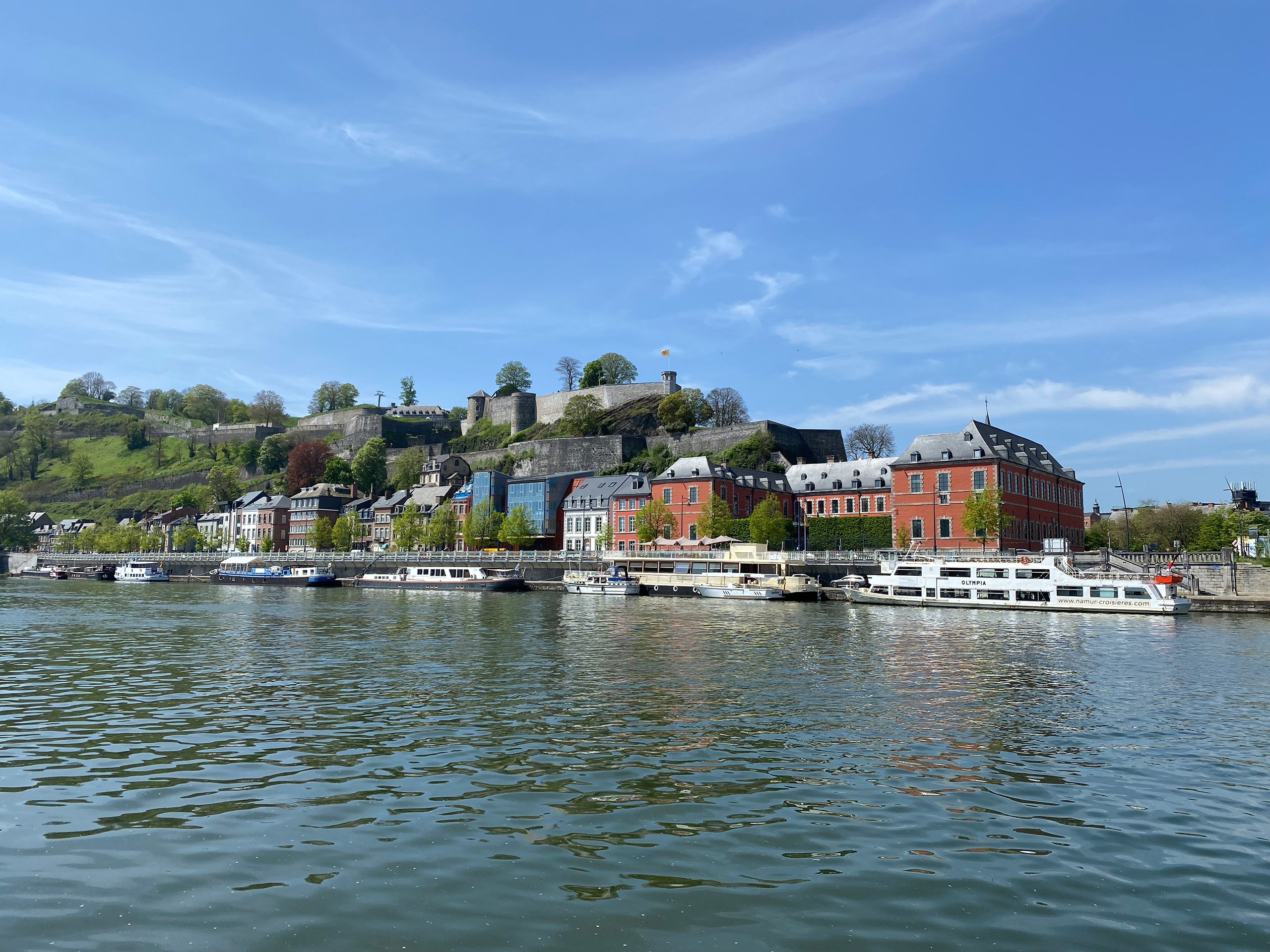
The station is also an excellent starting point for a trip: the Walloon capital, with its old town, the Sambre and Meuse rivers, and its citadel, begins practically right outside the door.
Leuven – a successful Total Work of Art
In Leuven, it is less a single spectacular detail than the interplay of different eras that makes the station interesting.
The historic station building by Henri Fouquet dates from the late 19th century and closes off the eastern side of Martelarenplein. Behind it, the station was later extensively modernized. Today’s platform canopy by Philippe Samyn and Partners introduces a contemporary accent with its sweeping steel structures without visually overshadowing the historic station.
The canopy should not be compared with the great train halls of Antwerp or Liège. Its strength lies instead in how successfully it has been integrated into the renewed station environment. The historic station building, modern platform area, forecourt, and connection to Kessel-Lo together form an exceptionally coherent complex.
The connection to the city is particularly attractive. From Martelarenplein, the perfectly straight Bondgenotenlaan leads directly toward the historic center and the Grote Markt. This axis was deliberately designed so that the station appears as the visual endpoint when viewed from the city center.
For travelers, it is ideal: leave the station, cross the square, and continue almost straight toward the town hall.
Tournai – a monumental Introduction to a magnificent City
Tournai may not be a station worth crossing Belgium for on its own. In combination with the city, however, it is an exceptionally strong bonus.
The station building was constructed to designs by Henri Beyaert in the Neo-Renaissance style and inaugurated in 1879 in the presence of King Leopold II. Beyaert was one of Belgium’s most important architects of the 19th century, and the prestigious façade makes clear how significant a railway station could be as the gateway to a city.
On the track side, the complex becomes much more restrained. The station draws its character above all from its city-facing façade and from the impression it creates on arrival.
That suits Tournai perfectly. Beyond the station lies one of Wallonia’s most interesting historic cities, with the Cathedral of Notre-Dame, the Belfry, and the Grand Place.
Tournai is therefore a typical bonus station: the station itself is worth seeing, but above all it makes you want to step outside and explore the city beyond it.
Schaerbeek / Schaarbeek – Railway Station and Railway Museum
Schaerbeek in Brussels is the logical conclusion to this list – especially for railway enthusiasts.
The present historic ensemble began in 1887 with a stone station building designed by Franz Seulen. The building is in the Flemish Neo-Renaissance style and was later expanded. With its gables, small towers, contrasting brick and pale stone, and rich decoration, it looks almost like a miniature railway castle.
The platforms themselves, by contrast, are considerably simpler. Anyone getting off here might wonder why Schaerbeek appears on this list at all.
The answer lies in the historic station and directly beside it: since 2015, it has been part of Train World, Belgium’s railway museum. Historic locomotives, carriages, technology, design, and the history of the Belgian railway network are presented here in an authentic railway setting.
Schaerbeek is therefore less a classic tourist destination because of the station alone than a recommendation for anyone who wants to delve even deeper into Belgian railway history after reading this article. It is hard to imagine a more suitable place for doing so.

 © VisitBelgium.net
 © VisitBelgium.net
 © VisitBelgium.net
 © VisitBelgium.net
 © VisitBelgium.net
 © VisitBelgium.net